Francisco X. Alarcón
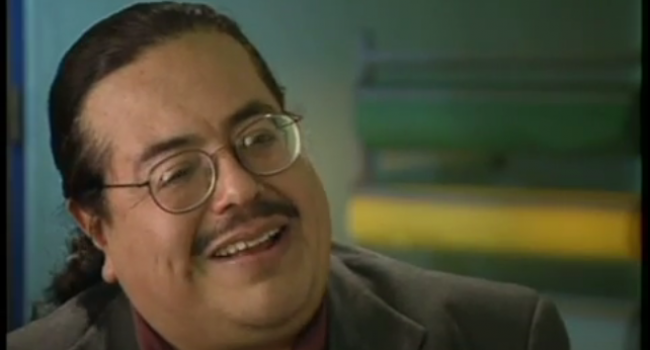
Francisco X. Alarcón was an award-winning poet who wrote for both children and adults. Born in Los Angeles, Califonia, he considered himself "bi-national," having spent time as a child in both Mexico and the United States. He expressed this in a poem: "I carry my roots with me all the time/Rolled up I use them as my pillow." Alarcón's poetry was inspired by songs he heard from his grandmother, which he presents for readers in both English and in Spanish.
Alarcón also spoke Nahuatl. Discover how this trilingual poet incorporated his grandmother's Nahuatl language into his work and hear him read some of his poetry in our interview below.
Bonus Video
See Alarcón in action at a poetry workshop with students at Oyster-Adams Bilingual School in Washington, DC!
Video Interviews
Transcript
A binational, bicultural, trilingual poet
In the 1950s, my mother went back to Mexico, married my father, and then I was born in Wilmington, California too. And in the 1960s, my family moved to Mexico. So it seems very interesting that in my own background I can see the moving back and forth. For us the border doesn't really exist, and has not existed for the last--I would say--one century. And to me that's very interesting because I was then raised in Mexico, but I also came back to visit my grandma and my family in LA, and so I am a truly natural--binational, bicultural, and a bilingual writer. I write both in English and Spanish. My work as a poet reflects this life. Now, to me, this is interesting because it's not just me; I think this life reflects the lives of millions of Americans that basically have this bilingual background. There are about 40 million Latinos now in the States, and I think the majority of those Latinos at this moment are bilingual, they have this connection with the Spanish language, and I want to keep that, to me it's very important. Maybe that's why I became a professor in Spanish and also a writer. And in the last few years, I have become a writer for children, so to me the connection with the culture and the connection with the language is very important.
Being bilingual
I would not be the same person if I did not have my second language, in this case English, or my first language, Spanish. To me, that makes who I am as a person, as a human being, provides me with tremendous access to the memories of my family. Imagine, you know, if I did not have access to the memories of my grandma or to my grandfather, if I cannot talk to my uncles in Spanish. I would be very poor as a person. And so, to me, it's very important, it's crucial, it's essential, that children maintain their family language, that they are able to connect with their parents, with their grandparents, with their family, so they can have access to memories and to wisdoms that they will never learn from books. And also for other children to learn a second language, so that they can establish friendships with other human beings, they can see how people feel about certain things. You know, I teach at the university level, and let me tell you, I think a lot of children come to me, a lot of students say, you know, "I'm very happy, very glad that I learned a second language when I was a child." So I would say to children, it's probably the most important investment that you would do. To keep your language or learn a second language. And children are the masters, they are the master learners. They're the ones that learn like natives the second language, and I think that there's not a better investment for the United States to invest on a second language, you know, a learning experience for children. And so they can be the ambassadors. And I think that, here we are, there are three billion human beings. Yes, English is spoken by a lot of people, but there are a lot of languages that we need to maintain, and we need to keep, and I think that for the human-I think it's tremendous-the pressure of who we are as human beings.
First day of school
So I'm gonna start by reading a poem from my collection of poems, "Angels Ride Bikes," "Los ángeles andan en bicicleta." It's a collection of poems that has to do with my own family. It's a celebration of my own family that lives in Los Angeles. And I'll read the poem that is titled "First Day of School," and it's about my own experience after going to school for the first time. I'll read it first in Spanish and then in English.
"Primer día de clases"
Parado frente a la "teacher"
Apreté aun más fuerte
La mano de mi abuela
La teacher se sonrió
Dijo algo en inglés, pero yo no entendí
Mi abuela luego me dio su bendición y se fue
Yo me quedé hecho silla en un mundo muy extraño.
In English…
"First Day of School"
Standing before the teacher
I squeezed my grandma's hand even harder
The teacher smiled, said something in English, but I did not understand
My grandma then gave me her blessing and left
I felt like a chair left behind in a very strange world.
Guardian Angel
"ángel de la guarda"
Cuando más triste y solo me sentía
Queriendo llorar en el salón
La niña sentada al lado mío
De pronto la mano me tomó
Y con los ojos más negros y tristes
Que he visto jamás
Me dijo sin palabras
"No te apures, no estás solo"
"Guardian Angel"
When I felt so sad and all alone
Wanting to cry in the classroom
The girl sitting next to me
Suddenly held my hand
And with the darkest and most tender eyes
I've ever seen
Told me without a word
"Don't worry, you are not alone."
Becoming a poet
I believe that I became a poet, a writer, when I was transcribing my grandma's songs in Mexico. I was about 15 years old. And my grandma used to sing with the mandolin a beautiful song that she used to play, and I thought at that point that she was basically singing from the old tradition of Mexico. But then I became aware that those were her own songs, but she had never written down the songs herself. So I decided to then transcribe the songs, and I would listen to her, and then write down the songs. They were very beautiful songs, in the Hispanic tradition of Guatecos and the ballads and so forth. And so, sometimes I would forget a line, I would have to make up for the line because I don't have a good memory, and so that's how I think I was able to compose my first collection of poems in trying to retrieve the memory of my own grandmother. And so later on, I went to the State of L.A., I went to school, I got together with other writers, then I became a writer, and I published her first collection of poems in 1985 when I was at Stanford.
The bellybutton of the moon
I was writing my second book of poems for children, "From the Bellybutton of the Moon," and I was having problems with that collection. You know, the poems were not coming through. And I told my mother, and my mother said to me, "Francisco, come with me. Let's go to Mexico this summer. Let's go back and, you know, and so you can live again when you were a child and you visited that little town," her hometown. And so I went with my mother, and my father, and my siblings to this town for one week, and let me tell you, in one week that I was there, everything becomes clear again in my mind. And I come back and I wrote a book in a few days. And that to me was a lesson, saying, you know, you cannot take it, at least in my kind of poetry that I write. I don't write fiction. Fiction to me is not part of my vocabulary. I write about testimonies, about life, about, you know, what happens to me, what happens to my friends, what happens to my family, what happens in the world.
Trilingual poems
And I've done collections of poems, one called Snake Poems, for example. Snake Poems took a lot of research because I went to Mexico, I spent years doing research. I found a manuscript written in 1649 by a guy named Hernando Ruiz de Alarcón, and this is a trilingual book in Spanish, English and Nahuatl. And so there was a lot of work on that collection, and maybe it's one of my best work. And people did not know what to do with the poems, because the poems were in the tradition of the Aztecs, and they were written in English in Mexico. I mean, talking about being transcultural. I wanted to write the poems in Spanish. They didn't come out in Spanish, they came out in English, because in that setting, Spanish was the colonial language that basically was imposed on the Indians, and so English allowed me to be more neutral in that way.
Writing poetry in two languages
Writing poetry in two languages, it's a challenge. That was one of the questions that we had today from the children. I write both in English & Spanish and sometimes the poem is impossible to translate into another language. And I think I'm aware of that. So you try to do the best you can. Just to give you an example, I have a poem in English in my first book called "Green" and the one stanza that says "And everybody had a green thumb." And I loved the idea of everybody had a green thumb, it's the green of the future, basically, everybody becomes a gardner. But how do we say green thumb in Spanish? We can't say green thumb in Spanish, so I had to use another way, translating that to: "Y todos tenían buena mano para plantar." But it doesn't carry the meaning of a green thumb. So that is the language, so the English is much better than Spanish because English carries the green thumb. In Spanish we don't have that. So I become aware of the limitations of translating, basically, and sometimes a poem works very nicely in Spanish and not very good in English and the opposite, sometimes a poem works very good in English but not in Spanish. So that to me, I'm very aware now of the risks of translating and I think translators are always, basically, not final, but they just compromise.
The writing process
I don't believe in mystifying the poem. You say, "Well, give it to me, and it's complete, it's final, I cannot touch it." On the contrary. I say, "No, no, no. Let's revise it." And sometimes I have poems that are this big, this long, and, you know, it's the process of doing this, you know? This is a process for me, it's a natural process. So long poems that had the first time, you know, 20 stanzas, at the end come out with five stanzas. For me, a poem should be not artificial. Nothing that is in a poem should be in a poem that is not necessary, you know? I don't believe in flowering words, I don't believe in a lot of artists, you know, it's just the scheme, and so to compare it to the point that it's a jewel, that's the poems that I like. And so it takes time, it takes time to do this. I'm in the process right now, with the new book that I was telling you that is called "On Monday I Feel Like a Dragon." It's my new book about the days, and I have little poems like this and they are going like this right now [presses hands together], you know? They are collapsing, you know? Something that's-it's like a dark hole. You know, there's a process of collapsing, of non-repetition, of trying to, you know, get the sense of what the poem is all about, and I think, to me, it's a question, it's a challenging, you know, endeavor that I have at this moment. You know, I'm trying to say everything with few words, you know, and I think that in certain collections of poems I'm able to do that, I am very happy to be able to do that.
A poem is incomplete
For me, a poem is not about ideas. It's never an idea that I have. It's basically an image or a sense, mostly images, that have to do with the senses, and so the five senses, and then from the image, then, you know, I have to write it down. And so, once I start writing, it's almost automatic, you know, the next line follows. It's not planning, I don't plan collections of poetry. I know that all the poets, they have, you know, like guidelines of what they want to write. I have no guidelines, basically, you know. I don't know what the poem is going to be when I start writing the poem, but then, when I see it, I know that it's complete. And for me, a poem is incomplete. I don't like poems that are flowery and complete, that give you everything. I believe a poem, by nature, is incomplete and it has to be completed by the reader and the listener, and so the poet is only providing--like a Japanese landscape--a few strokes, and the viewer has to complete the landscape. And it's engaging. I recall there is a Latin American writer, Julio Cortázar, "y eso de lector cómplice," you know, the reader that becomes an accomplice. And I believe that, you know. A few strokes are, for me, enough to communicate my feeling.
The oral tradition of poems
I belong to the tradition, of the old tradition, and my poetry--when I read my poems--they have to be aloud. I cannot read my poems in silence, even though I am in airplanes. I will be reading the poetry and I will read it aloud because I will be, you know, whispering the poetry, because poetry, I really believe, has to do with a sense of communicating and the idea of reading the poem, giving life to the poem, is important, and so the old tradition is very important. And it's very interesting that most of my poems, they don't fit the traditional scheme of either English or Spanish, because they're not bilingual most of the poems, and most poetry written for children are set in, basically, in stanzas of four lines. My poems are mostly in stanzas of three. And I believe, you know, I've come to the conclusion, the reason why I use three verses in a stanza is because number three is just an incompleteness, you know, almost hanging there, you know? And so the question for me of poetry is really more of a question than an answer. My poetry doesn't really provide answers. They are really posing questions, and I think the reader becomes engaged in this talented process. And so, yes, being a poet in the old tradition means that my poems are totally oral.
Poetry empowers
I tried to do an assignment, what I call free association, and somebody had a poem about his father, you know. And the poem was so moving because the poem started like: "My father is tall and strong, and when he sees me, he laughs." And, you know, and those three lines, that he read, the child, you know, [snaps fingers] really had an impact on me, because here I am as a poet that comes from California to this school, and then the child had never written a poem, and I had just talked about, you know, memory poetry, about, I'll write about a person, and, you know, we were doing a free association, but I did mention that it was nice to select a member of a family to write about. And in no time, he was trying to communicate his feelings about his father. That to me is empowerment. It's about your providing children, you know, you can write about your family. It's important for you to write about your family. It's important that you reflect about your own life. And I think in poetry you can do that very fast. They don't have to take a workshop, you know, that will last a few weeks for them to do this. They can do it in no time, right there, on the spot, let's do it. And then he, you know, he got up and he read his poem, and he was very moved. Last time that I came to Oyster, just to hear what we can do for children, I had the same experience with somebody else that wrote a poem about his father. The poem was, you know, it made me cry, basically, when he read it. It was about his father saying, you know, "My father is a plumber, and he comes home with the dirty hands. Nobody respects him, but I do have tremendous respect for my father," and goes on. And I was like, very moved and the teachers also were very moved. But, you know, it was in Spanish and then he did the translation in English. And then he sent the poem to a literary contest in the Library of Congress and he won first prize. And then, not only that, the father was so moved that even though they come from a low-income background, he got a computer for his son so he can get a computer to write more. And not only that, he was offered then a fellowship to go to an academy here in Washington, D.C. So, this kid, his life changes because he wrote one poem in the classroom situation, you know? To me, that's what poetry is all about, it's about changing people, it's about changing who we are, what we think about each other.
What schools can do
I think there are a lot of things that schools can do. And I think to basically provide children with access to all the writers that write not only Spanish, but all the languages in the United States, would be important. I think that, you know, if you go to a lot of libraries and bookstores, you will find a lot of books about cats, about dogs, but try to find books about Latinos. You know? There will be, in most bookstores, none. For children. None whatsoever. This is, you know, to me it's almost a disservice when you have, you know, millions of Latinos, children, basically, that are American, that are born here in the States, that are English learners, and they need to be provided with tools, they need to be provided with role models, and yet we don't find those in bookstores or schools. And I think it will be important to open up, you know, the idea of, you know, it's OK to be American and to be bilingual. It's OK to be Latino, to be dark-skinned, to speak Spanish as a first language. It's OK. It's America. No problem with that.
Biography
Francisco X. Alarcón was a bi-national, bi-cultural, trilingual poet and educator, speaking English, Spanish, and Nahuatl. His children's books vividly paint pictures of Latino culture, family, fun, and flavor. Alarcón also directed the Spanish for Native Speakers Program at the University of California, Davis.
For Alarcón, who was born in the U.S. but also lived in Guadalajara, Mexico as a child, the border didn't really exist. Like many other Mexicans at the time, Alarcón's grandparents moved to the U.S. following the Mexican Revolution (1910-917). They returned to Mexico after the Big Depression. Alarcón's U.S. born mother and uncles returned to the U.S. in the 40s during the war effort. Alarcón worked as a migrant laborer while studying at Stanford and encouraged his siblings to continue their studies.
Alarcón died in January of 2016 following a battle with stomach cancer.
In this Los Angeles Times obituary, his sister Esthela says, "He said he would never use a period until he died."