Colorin Colorado: Helping children read... and succeed!
A bilingual site for families and educators of English language learners
  • small text
  • medium text
  • large text
  • print

Reading Instruction for ELLs

These books offer a number of practical research-based strategies for ELL reading instruction, including ideas for lesson plans and assessments.

 Literacy Instruction for English Language Learners: PreK-2
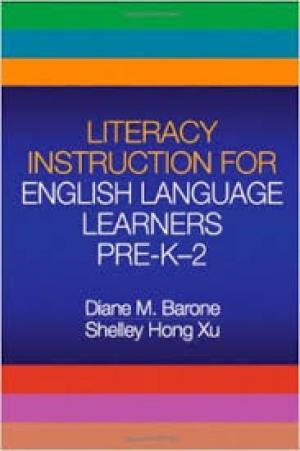
Literacy Instruction for English Language Learners: PreK-2
By: Diane Barone, Shelley Hong Xu
The Guilford Press

This book is a must-have for anyone who teaches ELLs in Pre-K through second grade. Each chapter is packed with practical, research-based strategies that teachers can immediately put to use in their own classrooms. The discussion focuses on working with ELL families, choosing appropriate instructional materials for ELLs, and effective instructional practices in: oral language development, assessment, writing, comprehension, spelling, vocabulary, and phonics. Throughout the book, Barone and Xu summarize current research in literacy instruction for ELLs, but their emphasis is on specific strategies that translate that research into effective classroom teaching.

English Learners: Reaching the Highest Level of English Literacy
By: Gilbert G. Garcia (Editor)
International Reading Association
(2003)

This book examines three important ELL issues: English reading instruction in an immersion setting, English language development, and cultural issues as they pertain to ELLs in and out of the classroom. Readers will discover new ways of looking at practice in the context of current English literacy instruction for ELLs, suggestions for why we need to examine our current practice, and recommendations for what we can do to change it. The authors emphasize the importance of cultural heritage and celebrate the variety of voices that our ELLs represent.

Fluency Instruction: Research-Based Best Practices
By: Timothy V. Rasinski, Camille L.Z. Blachowicz, Kristin Lims
The Guilford Press
(2005)

This text brings together experts in the field of fluency research and practice to discuss what is an often-overlooked component skill of reading. The book is divided into three sections. The first offers a very accessible discussion of fluency theory and research, including an introductory chapter on the history of fluency research. The second section of the book, which is devoted to effective fluency teaching, has descriptions of a variety of programs and practices that are based in sound research. The final section discusses fluency instruction with special populations, such as struggling readers and adult English language learners. Filled with useful and practical information, this book is a great resource for any professional library.

Literacy Assessment of Second Language Learners
By: Sandra Rollins Hurley, Josefina Villamil Tinajero
Allyn and Bacon
(2001)

Product Description: Literacy Assessment of Second Language Learners consists of articles written specifically for this book by national and international experts and teachers in the field of literacy/bilingual assessment. The authors include assessment instruments, such as grading rubrics and observation checklists; classroom vignettes at the beginning of each chapter that integrate theory and practice; and numerous pedagogical devices such as charts, graphs, and summaries to make the book easy to use for readers.

Literacy Instruction for English Language Learners
By: Nancy Cloud, Fred Genesee, Else V. Hamayan
Heinemann
(2009)

In this must-read guide, experts Nancy Cloud, Fred Genesee, and Else Hamayan lay out a research-based yet practical and accessible approach to reading and writing instruction for ELLs. Designed for ELL teachers, mainstream teachers, and reading specialists, the book offers an excellent foundation on what we know about literacy development in ELLs before offering numerous classroom strategies on topics such as: emergent literacy in a second language; helping ELLs become biliterate; academic language and literacy; connecting reading and writing; and assessment. The book is full of classroom examples, extra tips and research questions, recommended resources, and useful skill charts, presented by the authors in a thoughtful, comprehensive, and clear format.

Literature-Based Reading Activities
By: Ruth Yopp Edwards, Hallie Yopp Slowick
Allyn and Bacon
(2005)

This text presents a series of activities and ideas for implementing a literature-based reading program. Theoretically supported exercises for grades K-8 are included, as well as universal activities applicable to books of all levels. In addition, the book discusses practical, decision-making guidelines for literature instruction.

Month-by-Month Phonics for Upper Grades: A Second Chance for Struggling Readers and Students Learning English
By: Patricia Cunningham, Dorothy P. Hall, Gene Shanks
Four Blocks

This book, highly recommended by upper elementary, middle, and high school teachers, offers monthly activities, sample lessons, and word lists to help students become fluent decoders and spellers. Students will learn how to apply reading and writing strategies through age-appropriate strateges.

Partnering for Fluency
By: Mary Kay Moskal, Camille L.Z. Blachowicz
The Guilford Press
(2006)

This volume, which is part of the Tools for Teaching Literacy series, provides a wealth of research-based, classroom-tested strategies for teaching reading fluency. Topics include fluency assessment, resources for fluency instruction, planning for instruction, and how to design staff development to encourage good fluency instruction. Of particular interest is the chapter entitled, "Student Partners for Fluency Development," in which the authors discuss how to effectively pair students for classroom fluency work so that they can take responsibility for their own learning and support each other's fluency development.

Reading Comprehension: Strategies for Independent Learners
By: Camille L.Z. Blachowicz, Donna Ogle
The Guilford Press

This practical but comprehensive guide to reading comprehension instruction begins with the question, "What do good comprehenders look like?" What follows are detailed descriptions of seven students, representing different ages and backgrounds, all of whom are skilled, successful readers. The authors use these descriptions as a basis for their definition of comprehension. Chapters include strategies and cover classrooms that support comprehension instruction, comprehension assessment, comprehending fiction, reading to learn information, vocabulary instruction, research skills, and studying and test taking. Recommended for teaching ELLs as well as native speakers.

Reading, Writing, and Learning in ESL: A Resource Book for K-12 Teachers (4th edition)
By: Suzanne F. Peregoy , Owen F. Boyle
Allyn & Bacon;

This Fourth Edition of Peregoy & Boyle's text continues the strengths of the third with its comprehensiveness and accessibility, providing a wealth of practical strategies for promoting literacy and language development in English language learners (K-12). Unlike many texts in this field, Reading, Writing and Learning In ESL takes a unique approach by exploring contemporary language acquisition theory as it relates to instruction and providing suggestions and methods for motivating and involving ELL students.

Research-Based Methods of Reading Instruction for English Language Learners: Grades K-4
By: Sylvia Linan-Thompson, Sharon Vaughn
instruction for English language learners: Grades K-4. Alexandria, VA: Association for Supervision and Curriculum Development

This practical and accessible guide is organized around the five key components of reading instruction. The authors begin each section with a clear description of why instruction in that particular component is important and what that instruction should look like. The book includes descriptions of more than 60 lessons that can be adapted for many different levels of instruction, as well as a very useful glossary of terms related to literacy and English language learning. Clearly written and well-organized, this book would be equally useful to veteran reading teachers and teachers who are exploring reading instruction for the first time.

Strategies That Work: Teaching Comprehension to Enhance Understanding
By: Stephanie Harvey, Anne Goudvis
Stenhouse Publishers
(2000)

Reading implies thinking and understanding, and teachers can help children develop strategies for comprehension. Children need to know how to make connections and ask questions, how to visualize and infer, how to extract important ideas and to synthesize information if they are to become fluent readers. Stephanie Harvey and Anne Goudvis show how teachers can model these strategies by thinking aloud and coding the text, lifting text onto the overhead and reasoning through it in class discussions, and bringing in their own books to model how adults use these strategies.

Teaching Reading to English Language Learners: Grades 6-12
By: Margarita Calderón
Corwin Press
(2007)

In this guide, literacy expert Margarita Calderón offers a number of strategies for teaching reading at the upper grades, including vocabulary development, comprehension, and reading in the content areas. She provides a number of hands-on examples throughout the text, and addresses the challenges of teaching basic literacy skills to older students.

The Best for Our Children: Critical Perspectives on Literacy for Latino Students
By: Maria de la Luz Reyes , John J. Halcón
Teachers College Press

In this intriguing text, Reyes and Halcón present the perspectives of prominent Latino researchers and educators on issues related to literacy development for PreK-12 Latino students. The focus throughout is on the critical need for learning environments in which Latino students' culture and language are respected and nurtured. What makes this volume unique is that each of the authors can draw upon his or her own personal experience in discussing such topics as bilingualism and biliteracy, engaging adolescent readers, and academic underachievement.