

I was planning on attending the Alliance for Excellent Education’s CCSS/ELL face to face and webinar events in Washington, DC last week and blogging about them.

Learn more about common myths related to English language learners (ELLs) and special education along with strategies for identifying and supporting students' strengths and needs.

ELL experts Ruslana Westerlund and Kristina Robertson have compiled 8 common myths regarding ELs that they think administrators should reconsider, as well as supporting research for their responses to each myth, best practices, strategies, and recommen

Albuquerque teacher Ali Nava describes the "realia" activity she used to introduce Burro's Tortillas and some of the items she brought into the classroom for the lesson.
The Education Department's Institute of Education Sciences reviewed a number of instructional strategies for English language learners and provided a summary of their recommendations.

Visuals can be a powerful way to engage students, help them make important connections, and make new content and vocabulary accessible.
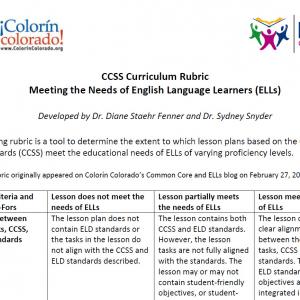
When asked to review these curricular units, I realized I needed a rubric to help me take an objective look at them and be able to share the results with the curriculum writers.Dr. Sydney Snyder and I developed the rubric below and found that it’s been helpful in framing our own thinking.

In this lesson, students read an excerpt from the novel Travels With Charley by John Steinbeck about a man who takes a road trip with his dog.