
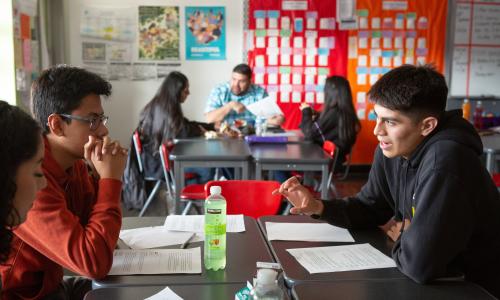
Are there students in your English language development or foreign language classes whose voices you do not often hear? Do your students squirm in their seats during their peer's presentations, only thinking of their own presentation while their classmates are speaking?
Mari's answer to these questions was a resounding "yes" until she started doing debates. Harvard professor emeritus Catherine Snow’s ideas about structuring academic controversy in the classroom completely changed the way both Mari and Aaron approach their unit planning and assessments. While they used to simply have students present about a topic, now, they look for ways to turn those topics into spirited debates. In the following article, they will describe the value of debating, outline the process of preparing for them, and provide materials so that you can try this approach with your own classes.
The Value of Debating
Educational consultant Jeff Zwiers argues that authentic conversations, such as those in debates, are highly motivating and engaging. Students can develop rhetorical skills such as ethos (credibility), pathos (emotion), and logos (logic) to strengthen their arguments through the use of emotion and anecdote, as well as data and case studies. According to Zwiers, these types of conversation skills can transfer across disciplines and will be critical to students' futures in fostering relationships, empathy, and perspective-taking. In an increasingly polarized world, understanding other perspectives, building evidence-based arguments, and engaging in respectful discourse are essential.
Debating also offers the opportunity to develop all four language skills by reading sources to understand the issue at hand, writing and drafting ideas to process one’s thinking, and, of course, developing speaking and listening skills through interaction during preparation with one's team and the debate itself. As students work their way through this process, they are gradually moving through Bloom’s taxonomy by first understanding a controversial topic, analyzing various arguments for and against it, and then evaluating the issue in question by developing an evidence-based argument.
In their English courses, Mari and Aaron explicitly teach the language of argumentation, which is one of the four key language uses that all students must practice across their content and language classes. Specifically, to debate effectively, students must learn different ways of several discussion skills, including:
- Introducing arguments
- Adding evidence
- Explaining evidence
- Contrasting ideas (i.e. providing counterarguments)
- Rebutting (i.e., refuting a counterargument)
- Conceding (i.e. opening the door to another idea and then closing it)
- Emphasizing a point
- Showing cause and effect
- Summarizing
- Concluding
Students must also learn how to evaluate evidence to support their claims, organize their arguments into clear paragraphs, and present their arguments with strong speaking skills. This learning can transfer across the curriculum, but debates are particularly well aligned with language arts standards, such as the Common Core English Language Arts Standards and ACTFL Communication Standards. In other words, while debates may prove to be beneficial in any content area, they are particularly well suited for ELL and foreign language courses because they encourage students to develop all three dimensions of academic language in an authentic context.
Preparing for Debates
Whether you are planning to spend one week or an entire six- or eight-week unit on the debate, there are four primary steps to follow including: 1) choosing the topic, 2) building background knowledge, 3) writing and rehearsing introductory speeches, and 4) rehearsing rebuttals. Depending on how much time you have, you could spend one lesson or one week working on each step. The steps are discussed in detail below to help you prepare for your own debates.
Step 1: Choosing the Topic
Before you start searching for new topics, take a look at the content that you are already planning to teach or review units that you have taught in the past, and develop a debate question from that existing material. Mari uses the Cambridge IGCSE English as a Second Language Coursebook to plan units for her English classes, so to begin a debate, she chooses a topic from the book and develops a list of controversial questions about that theme that have two clear sides to an issue. For example, for a unit about transportation, she generated the following debatable questions and allowed the students to vote for the question that they liked best:
Should people use electric vehicles in our town?
Are electric vehicles more harmful than beneficial?
Should our town rebuild the public transportation system?
Should we ban taxis in our town?
Her students chose the first question above, so their debate was personal to the community where they live. Another way to personalize the debate questions would be to have the students write their own. You could provide examples of high-interest debate questions like these that she has used in the past:
- Should cellphones be banned during the school day?
- Is artificial intelligence (AI) more harmful than beneficial?
- Is fame more harmful than beneficial?
Each of these questions could be answered affirmatively (i.e. yes, because…) or negatively (i.e. no, because). This clarity is especially important for younger learners and learners with lower English proficiency because they must know exactly what they are arguing for or against. On the other hand, debating questions that start with "to what extent" can allow for more nuanced argumentation. For example, students in an advanced language course or those who are nearing the end of high school could benefit from questions like:
- To what extent should schools regulate students' cellphone use during the school day?
- To what extent is artificial intelligence (AI) more harmful than beneficial?
- To what extent is fame more harmful than beneficial?
To debate these kinds of questions, students must develop a deeper understanding of the topic. Rather than approaching it from an all-or-nothing perspective, they must think about how much they agree or disagree and why they hold this opinion. This evaluative and analytical thinking is an essential part of any curriculum, but if you are teaching in an IB school, debates that start with "to what extent" are particularly useful in preparing students for their Theory of Knowledge courses. No matter your context, choosing your debate topic should be relatively straightforward; start with the materials that you already teach and generate a debatable question.
Step 2: Building Background Knowledge
Once you have written your question for the debate, start by getting an understanding of your students' prior knowledge. What do they already know about the topic? What opinions do they already hold? Where do those opinions come from? If Mari is planning to work on a debate for six to eight weeks, she typically spends several days trying to learn everything she can about the students' understanding. In the beginning, she usually has the students write as much as they can about the topic in any language(s) that they speak.
She synthesizes everything from the student by asking them to translate their ideas in their own words or with the help of translation tools into English. Then, she thinks aloud as she is organizing their ideas into one cohesive, combined paragraph for the class. (i.e. "Johnny, can you tell us in English about what you wrote in Portuguese here?...Great! That fits with what Melissa was saying, so I am going to put what you know about the topic into one sentence by writing...")
Next, she often uses activities like four corners, opinion lines, or QSSSA to get students to dig deeper into what they already know and believe. As she is listening to students talk about their opinions, she makes notes about their ideas so that she can choose which information to share with them to give them a different perspective.
After she has a general idea of the students' prior knowledge, she spends several class periods building background through texts, videos, and guest speakers. She encourages students to interview experts in the issue that they are debating, and she has them speak with their friends about the issue as well. Then, she typically asks the students to vote for the team that they would like to be on (i.e. affirmative or negative), and she assigns the teams based on these responses. With more advanced learners, she often assigns them to the team that is opposite of their beliefs so that they must rise to the challenge of arguing a differing viewpoint.
Before students begin writing their speeches, she deconstructs several examples with them so that they have a model of what their speeches will look like. Sometimes she can find real-world examples of prominent speakers talking about the topic, but other times, she writes her own example or uses AI to generate a variety of speeches. We take apart the language in these speeches to see what kind of transition words the speakers are using and for what purpose. When educational consultant Dr. Ruslana Westerlund visited Mari's classroom during this stage of one of their debates, she wrote an article about the experience. In her article, Dr. Westerlund wrote about the importance of text deconstruction to help students understand the function behind certain phrases in the English language.
Step 3: Writing & Rehearsing Introductory Speeches
Once the students have deconstructed model speeches, the students meet with their teams to generate as many arguments as possible. Then, they each choose three different arguments, and write their thesis statement for their unique debate speech with the following formula:
I argue that_______because reason 1 + reason 2 + reason 3.
Each of the reasons that they have listed becomes one body paragraph in their speech, and each of those paragraphs has a Point, Example, Explanation, and Link (i.e. conclusion). Depending on the goals of the unit and the proficiency level of the language learners, to help the students write these PEEL paragraphs, Mari often provides a graphic organizer with various levels of differentiation (e.g. sentence stems, sentence frames, word banks). Sometimes, Mari also provides the students with a list of direct quotes from texts or interviews that we have used at the beginning of the unit so that they can use these as their examples in each paragraph. However, she has noticed that the students often have trouble explaining how the direct quotes connect to their argument, so it is usually more fruitful to have the students do their own research using search terms from their unique arguments.
When students are doing research to find evidence to support their arguments, Mari frequently invites the librarian to visit her class and do a presentation about ways to identify search terms and find reliable sources. At this stage of the process, it is key to explicitly teach how to use reference sources in a speech using phrases like "Based on evidence from…" or "According to…". Since a debate does not require a works cited page, these phrases for adding evidence are essential in helping students communicate where their information came from.
If students are using computers to type their debate speeches, Mari has noticed that more and more are turning to artificial intelligence (AI) to do their writing for them. She tries to discourage AI use as much as possible because, besides the fact that copying an AI-generated speech to pass off as your own is considered plagiarism, she wants to teach the students the skills that they need for each stage of the writing process. Therefore, she has started to spend more and more class time allowing students to write and revise their speeches by hand. That being said, AI can be a helpful tool for some stages of the writing process, so she always provides an AI stoplight to show the students how much AI they are allowed to use throughout the debate preparations. Mari primarily uses the yellow light and informs students that they are permitted to use AI to brainstorm ideas and receive feedback on the quality of their argumentation. If she decides not to allow the use of AI at all, she allows students to receive peer feedback or do writing conferences to help them practice revision and editing. Providing this clarity about how much AI students are allowed to use helps them take ownership of their arguments before sharing them with their peers.
Step 4: Rehearsing Rebuttals
The final stage of preparation before the debate is to rehearse the rebuttals, the act of refuting or contradicting other people's arguments. Dr. Ruslana Westerlund described the rebuttal as opening the door to someone else’s idea and then closing it again with a counterargument. Another way to conceptualize the rebuttal is to think about a game of catch. One person in the debate tosses a ball, their argument, and in order to respond, the other person must catch the ball and then throw it back. In other words, if you are rebutting an argument, you must acknowledge the other person’s argument with phrases like "You said that…" or "While it might be true that…"and then you must respond with a counterargument like "However…" or "I believe…because…". Mari practices these phrases with a literal game of catch in class. Students are paired up and one receives a tennis ball. They toss it to their partner while saying one of the arguments from their speech. The partner catches it by saying a phrase of concession, and then the student tosses the ball back while saying their counterargument. Mari challenges the students to go back and forth for at least five minutes, and the discussions generally become quite lively as they begin to get deeper into the topic.
Another way to practice rebuttals is by anticipating what the opposing team will argue and by writing possible responses. After reviewing the students' speeches, Mari summarizes the main arguments for each team into a graphic organizer, and she leaves space for the students on the opposing team to practice writing counterarguments. Then, she gives them written feedback about how they can better acknowledge their opponents' arguments and provide more persuasive responses. During this stage of the preparation process, she often teaches hedging words like "may, might, possibly, perhaps" to help students add more nuance to their rebuttals. However, she has found that concessive connectives like "while" and "although" are already challenging enough for most intermediate to advanced language learners. Practicing the language of rebuttals is crucial to build students’ confidence to speak spontaneously during the formal debate.
Debating & Reflecting
After completing all four preparation steps above, you are ready to run the final debate. Mari always shares the rubric and the format with the students before the debate so that they know what to expect. While she has tried different types of debate formats in the past, the most seamless format that she has found for 9th and 10th grade learners is as follows:
Speeches: Each student recites their speeches in front of the class while their peers are taking notes. Mari assigns the order of the speakers so the affirmative and negative team always alternate (e.g. a student from the negative team gives their speech first and then a student from the affirmative team gives their speech second and so on).
Rebuttal: Students stand in two lines or concentric circles facing each other, and using their notes from the debate, they engage in a short one to two minute rebuttal before rotating to a new partner.
Reflection: Students complete a survey to reflect on their own and their classmates' performance. Aaron films the debates so that the students can watch their performance again before completing their reflection.
Depending on the class size, this process could take up to 90 minutes, and to maintain the energy in the room, Mari has found it most practical to complete the debate in one class period.
Conclusion
At the end of the school year, when Mari asks the students what they liked most about English class, they most frequently mention the debates. When she asked them what they like about the debates this year, they said:
"I like giving my own opinion."
"I am exchanging ideas with the other team."
"I love the content!"
"Everyone is trying their best."
"The energy!"
"Everyone has a different opinion."
"Everyone participates!"
The students notice the engagement in themselves and others, they invest in the topic, they listen deeply to their peers, and they share their own opinions. They see firsthand that what they have to say matters and can have a real impact on what other people do or think. They continue their conversations from the debate into the hallway, and Mari hears them talking about the topic well after the unit has finished. Debates have not only changed the way Mari approaches the traditional classroom presentation, but they have also transformed her classroom into a space of meaningful communication and connection.
Materials
Related Resources
- Socratic Circles and ELLs: A Three-Part Series
- "Opening and Closing Doors for Other Voices": Teaching the Language of Rebuttals by Dr. Ruslana Westerlund (Making Language Visible)
About the Authors
Mari McCarville teaches German and English Language Acquisition at Leysin American School in Switzerland. She holds a master's degree in Curriculum and Instruction from the University of Denver, a master's degree in German Studies from the University of Colorado Boulder, and she is currently studying to earn a Doctor of Education at the University of Bath. In addition to teaching, Mari is particularly interested in educational research about second language acquisition and assessment for multilingual learners. Her current areas of study include developing oracy through debates and evaluating adaptive AI language proficiency assessments.
Aaron Deupree teaches English B for the International Baccalaureate Program at Leysin American School in Switzerland and is English Language Acquisition Coordinator and English Department Head, as well as Professional Learning Coordinator. He co-authored the recent English B for the IB Diploma course companion published by Hachette, and served as a member of the ECIS Multilingual Learning in International Education committee. Prior to living and teaching in Leysin, Aaron taught in Japan and South Africa. He holds a MEd in International Education.





Add new comment