

An essential first step for districts is identifying all MLs in a timely manner. Learn more about the federal regulations related to identification and communication with multilingual families about identification procedures.
Guiding Questions
- How are MLs identified?
- What action steps should be taken to ensure all MLs are identified?
- What is a Home Language Survey?
- What are the requirements for informing families when a child is identified as an ML?
Federal Guidelines: Identification and Assessment
Federal guidelines require schools to:
- Have a clear set of procedures and criteria for identifying multilingual learners;
- Use an assessment that measures English language proficiency in all four domains (reading, writing, speaking, and listening);
- Complete the identification process in a timely manner and notify parents/guardians about their child’s language assistance program within 30 days of enrollment.
These guidelines are described in: U.S. Department of Education (1999); U.S. Department of Justice, Civil Rights Division and U.S. Department of Education (n.d.-a); and the Every Child Succeeds Act (ESSA, Title III, Section 2, 2015).
Note: According to ESSA (ESSA, Title III, Section 2, 2015 , p. 59), when a child is identified as an English learner after the school year has already started, the school must notify the parents within two weeks of the child being placed in a language instruction program.
Some schools think they have 30 days to identify a multilingual learner or two weeks after identification to tell parents about placement in a language program. This is not true or practical. Instead, it is essential to have procedures to identify potential multilingual learners within the first few days of enrollment. Doing so ensures that each student is identified and placed into an appropriate language assistance program as quickly as possible. (See Communication with Multilingual Families for more information.)
A Note on Terminology |
|---|
The term multilingual learner [ML] refers to a diverse group of students enrolled in public and public charter schools whose primary language is other than English. Several acronyms have been used interchangeably to refer to MLs, including:
The strengths-based term multilingual learner is used throughout this document to recognize and value students’ existing language abilities and highlight what they know. Keep in mind that states may use different terms and that many federal documents use the terms "English learner" and "Limited English Proficient students." See the federal definition of a multilingual learner in Who Are Multilingual Learners? |
Home Language Surveys
In practice, many schools and districts use a Home Language Survey to screen potential multilingual learners. Some state education agencies [SEAs] furnish a mandated form. Schools and districts should check with their SEA to ensure they adhere to the laws. Please see our State Overview for state-specific resources.
Home language surveys typically include questions such as:
- What language did your child first understand or speak?
- What language do you or others often use when speaking with your child?
- What language does your child use most often when speaking at home?
- What language does your child use most often when speaking with family members?
- What language does your child use most often when speaking with friends?
When a parent or guardian responds that their child uses a language other than or in addition to English, the school must assess the child to determine whether the child is an ML or is proficient in English. However, the Home Language Survey is intended to be one of many means to identify potential multilingual learners. See additional information and sample Home Language Surveys in Chapter 1 of the English Learner Toolkit.
Note: Home Language Surveys are not intended (and should not be used) as the only means for identifying MLs. Federal law expects that local education agencies, under direction from their state education agency, will use state-approved assessments as well as parent/guardian and student interviews in a language that is meaningfully understood, teacher input, and student performance in class and on assessments to identify its MLs.
Case Study: Identifying MLs |
|---|
Let's examine three newly enrolled Kindergarten students. Consider the next steps that you would take as you read the examples.
Discussion QuestionsWhen we look closely at the three examples, the only one that seems clear is Juan Carlos. His mother indicated that he spoke a language other than English on the Home Language Survey. Does this mean that we automatically identify him as a multilingual learner? What about Bao and Laura? These examples underscore that Home Language Surveys are not intended and should not be used as the sole means for identifying MLs. As noted above, federal law expects that local education agencies, under direction from their state education agency, will use the following to determine their MLs: state-approved identification assessments; parent/guardian and student interviews in a language that is meaningfully understood; and student performance in class and on assessments. Figure 1.3 illustrates the identification process. |
Figure 1.3: Identification Process of Multilingual Learners
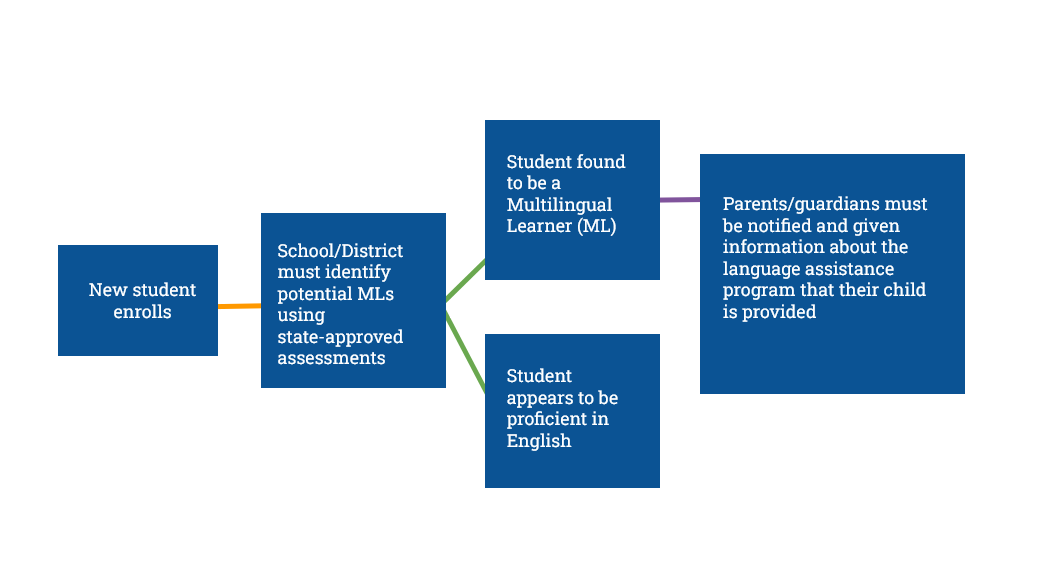
In addition, it is important to know that parents/guardians have a legal right to information in a language they comprehend meaningfully.
According to federal law, schools and districts must Schools must "communicate information to limited English proficient parents in a language they can understand about any program, service, or activity that is called to the
attention of parents who are proficient in English." (U.S. Department of Justice, Civil Rights Division and U.S. Department of Education, n.d.-b)
According to Every Children Succeeds Act (ESSA, Title III, Section 2, 2015 , p. 59) schools and districts must provide:
"outreach to parents of English learners to inform the parents regarding how the parents can—
(I) be involved in the education of their children; and
(II) be active participants in assisting their children to—
(aa) attain English proficiency;
(bb) achieve at high levels within a well-rounded education; and
(cc) meet the challenging State academic standards expected of all students."
Further, the Every Child Succeeds Act of 2015 amplifies the U.S. Department of Justice Civil Rights Division and U.S. Office of Civil Rights (2015) Information for Limited English Proficient (LEP) Parents and Guardians and for Schools and School Districts that Communicate with Them which states that schools must "communicate information to parents/guardians in a language they can understand about any program, service, or activity that is called to the attention of parents who are proficient in English. This includes, but is not limited to, information related to:
- registration and enrollment in school
- grievance procedures and notices of school programs nondiscrimination
- language assistance programs
- parent handbooks
- report cards
- gifted and talented programs
- student discipline policies and procedures
- magnet and charter schools
- special education and related services, and requests for parent permission for meetings to discuss special education student participation in school activities
- parent-teacher conferences."
The ESSA Act (2015) requires that schools communicate with parents/guardians of multilingual learners in a meaningful way so that parents/guardians can make an informed decision about their child. As such, schools must explain:
- why it believes a child is an English learner;
- the level of proficiency in English (e.g., how well the child speaks, reads, writes, and understands English) and how the child was assessed to determine this level of proficiency;
- the type of language assistance program that will support the child's language and academic learning needs and how it will help the child succeed in school;
- the steps that will be taken to support a child to become proficient in English and successfully transition from the language education assistance program. They'll explain the steps your child needs to take to finish the English learning program;
- if a child has a disability, the school will provide information on how the language education program will work in conjunction with a child's Individualized Education Plan.
Tools for Educators
These tools can support educators in identifying MLs. A PDF version of these questions is available.
Action Steps: Identifying Multilingual Learners |
|---|
Every local education agency (i.e., school and district) should assess the steps it takes to identify and assess potential MLs and inform parents/guardians of identified English learners of their child's participation in a language education assistance program. The following action steps, drawn from Zacarian (2023, p. 182), are intended for this purpose. These questions can guide a review of school and district Multilingual Learner [ML] identification procedures and policies.
|
Copyright© 2023 by Corwin. All rights reserved. Adapted from Transforming Schools for Multilingual Learners: A Comprehensive Guide for Educators, Second Edition by Debbie Zacarian. Thousand Oaks, CA: Corwin, www.corwin.com. Posted with permission from Corwin Press.







Add new comment