Can you tell us a little bit about your center?
We were founded back in 1967 and opened our doors in 1968. We were in a church basement up until about 2003 and then moved into our current location, where we've been for more than 20 years. We're not a faith-based school, but we were founded by 27 faith-based organizations around the Northern Virginia area because they saw a need for childcare for families that couldn’t afford private programs. Our mission is to offer high quality early childhood education regardless of a family's economic resources. So we do have children that pay the full tuition here, and then we have children that basically come for free. We work with a lot of organizations in Northern Virginia to make that happen in various ways.
We also offer breakfast, two snacks and a lunch every day, so that's included in the tuition and part of our programs. We have a lot of people that also help donate to our snack program because we want all children to have nutritious meals and to be able to keep their bodies strong in that way as well.
In addition, we serve English learners and the population can range anywhere from 30 to 50% of the total number of children. Currently, 35% of our children are English learners. We have families from all over the world, although the majority are Spanish-speaking.
How do you communicate with families?
Many of our families are still learning English, so we have software tools like Talking Points where families that speak different languages can communicate with our teachers in the language that they prefer. This makes it easy for the teacher to share something positive that the child did, share photos of artwork, and keep in touch. And then we work with parents on phrases and things needed to help a child feel comfortable and not so overwhelmed. We use interpretation to make sure families are understanding everything that we need to communicate, including if they need to talk with a specialist. When we do parent workshops, we always make sure there's a bilingual person there as well.
We also have teachers who have come from other countries and have learned English. Their message is, “We're here to help you. We want you to understand everything we're saying and help your child because navigating education in the United States can be so different from other countries.”
We also have a large kindergarten information night and go over the paperwork that's needed related to residency because in a lot of countries, you can choose the school you want to go to, and that's not necessarily the case here.
And so we do a lot of preparing for kindergarten, not only for the students, but for the parents. It can be very different from their own experience in their own country on whatever that country did educationally.
Tell us about your instruction.
We use Creative Curriculum, which is a project-based curriculum, hands-on and play-based. And so it really brings the curriculum to life when they can go to a bakery and see how they bake bread or go to a grocery store.
It also has literacy guidelines and lesson plans within that. So everything is labeled with a picture and words underneath in both English and Spanish and we add other languages children speak as needed. We have labels of the children's names everywhere, because that's something they are proud of, along with learning the letters within their name.
In terms of print awareness, we will do different colors for uppercase and lowercase to help with recognizing those differences. We use Play-Doh to make letters and numbers. We really want to expand on their vocabulary when we're reading books or within the curriculum. And we do a lot in small groups to work on letter sounds, rhyming, and talking about books together.
We also highlight oral language and conversation and ask students questions, like “How do you think you're going to get that block stable on top of that other block? What can we do to help with that?”
How do you teach science and social studies?
For social studies, it's really learning about the world around us. What is a community? How can we help each other? For example, our families brought in information about what countries they came from. We live in the Washington, DC area, so there's so much to see and we also do a lot through the Smithsonian museums. We actually have our own school bus and bus driver so that our students go on field trips. Our two-year-old class goes on one field trip a month, and our three- and four-year-old classes go on two field trips a month.
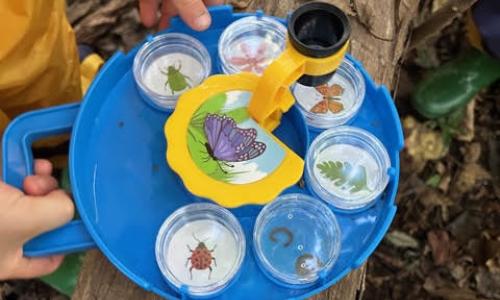
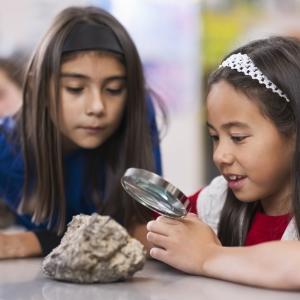
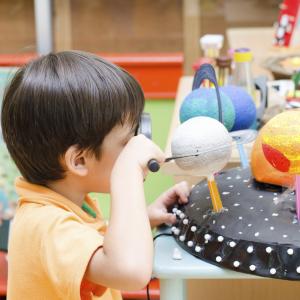
With science, for our Forest Days program, we are learning about nature and understanding the world around us, but also looking at how things change. One of our classrooms was working on an art gallery show, and they did an art project with salt and paint. How does that look different when you add different materials together or mix colors? We have science areas in each classroom where they have microscopes and things. We have a STEM lab in our multipurpose room with light tables where they can view things from different perspectives, but also looking at how things are changing and then asking critical questions on those changes.
This ties into our art projects too because we do an art gallery show every year. This year we're doing Salvador Dali. Last year, we did Vincent Van Gogh’s “Starry Night.” And so each class interprets that famous piece of artwork in the hallway and then gets to choose any other mediums they want for inside the classroom. We’ve used Kandinsky and Mondrian’s squares.
How are your classrooms staffed?
We have three teachers in every single classroom, and one of those teachers is Spanish-speaking since most of our English learners are Spanish-speaking and we want to make sure they have support in their native language. All of the teachers are lead teachers. The Spanish teachers are not assistants or aides – they are a true co-lead and they work with all children, not just English learners.
The majority of the day is in English, but there is a Spanish component when it's needed to help explain directions or information. In addition, we’ll read books in Spanish and English and our children who don't speak Spanish tend to pick up on Spanish phrases and Spanish words. But we're not a dual-language program. Spanish is used to help with clarification and with overall understanding.
What kinds of other supports do you offer?
We offer a plethora of free services and resources for children. Since brain development is so significant between zero and five, we want to make sure that our children have what they need to be successful in life, but also ready for kindergarten. This includes:
- Play therapy for our children with big emotions that need help with regulating those emotions
- Speech and language therapy for children that need help with articulation, phonemic awareness, and how words and letters sound. Sometimes the way their mouth moves doesn't reflect the actual sound.
- Occupational therapy for kids needing help with their fine motor, gross motor, and sensory processing, which is a new service. Since we had limited slots for our new OT, we focused on four-year-olds who would be going to kindergarten in the fall.
- Special education for kids with IEPs. We work with Fairfax County Public Schools through their special education department so children with IEPs can receive services while they're with us.
- Additional supports for children who do not qualify for the special education resources but need a little extra help
Why did you see a need for OT?
We began to see more kids needing more support with their motor skills and sensory processing. It may be related to the impacts of the pandemic, as well as more use of tablets at home.
For example, when children's hands aren't really strong, including the palm of their hands and their fingers, it's hard to hold a pencil and pick up things that are small. That’s so important as they move into kindergarten and start using writing utensils. Play-Doh and putty are a great way to help strengthen the grip. (Think about taking a child to a restaurant and the difference between tapping a screen or coloring.)
And with the sensory processing, we have kids who need to work through different kinds of sensory experiences. Sometimes they need some extra expertise to help them through that.
How is play incorporated into your curriculum?
We are a play-based program. It’s part of everything we do! Play is how children learn, navigate their feelings, and discover how the world works. When students learn about math, they count objects. We even started a “mathematizing the world” project with George Mason University a few years ago that asked questions such as, “What shapes do you see in the world? What math concepts do you see in this picture?”
And so it's really learning about everything around you and doing those critical thinking questions while they're playing to expand on their cognitive, social, and emotional development.
Tell us about your outside play!
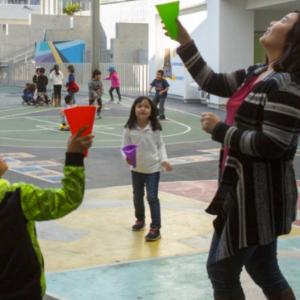
We spend at least two hours outside a day. It’s so important for children to be outside. Of course, we always follow the weather regulations, but we really feel it's important to connect with nature so that they can take care of it when they are older. There are also skills you need outside, such as riding a tricycle or climbing on a playground or using a shovel, which also helps those motor skills.
We also have a Forest Days program. You can learn about trees in a book, especially those we can’t see in Northern Virginia. But getting outside and learning how to take care of a tree is such a great learning opportunity. How can you tell if a tree is healthy or sick? How can you tell if a tree is always going to have its leaves or if they're going to fall?
We're also starting our gardening unit right now. Each classroom has a plot. Each year's a little different, but cucumbers tend to always do well in our garden. Students learn, “I can grow a cucumber and then it can come in for snack.” Then we talk about how cucumbers come from the farm, but how does it get to the grocery store? What does the grocery store do to get it to our tables?
What is your approach with technology?
The kids don't use iPads or other technology as part of our program. The teachers might use them to document things for assessments and we do use technology for parent communication, but for younger kids, hands-on is so important. When they are here, they're working with Legos, which are great for motor skills because you have to pull things off and put them back on. We're also using Play-Doh, putty, and ink stamps to help build those skills.
We just had a parent workshop recently and we asked the parents, what would you like more information on? And they all said screen time. I think everyone knows how important it is to limit screen time. But I think we also know we're now in this world that is just part of our lives and the children see us on our phones and checking emails. It was great hearing that they want to partner with us on that and that they are looking for ways to manage this and make sure their children get plenty of playtime at home.
Are you noticing any trends among kids born after the pandemic?
Coming out of the pandemic, we saw a lot of need for speech and language. My guess is that the need for OT and play therapy will continue; sometimes it just depends on the children and their needs. If they're going through something personally in their family life, they may need some extra help with how to regulate their feelings or what to do with their feelings.
During the pandemic, we also had to provide extra support to kids who didn’t have a chance to interact with other children as much. Now I feel like that's starting to level out a little bit. But I think social emotional growth and that development is a lifelong learning lesson.
Even as adults, we're still learning how to get along with others and how to communicate effectively. I don't think that ever really goes away. We want to help the children solve the problems themselves. At this age, they're always going to need a little help with doing that with friends. But learning how to say, “I don't like that,” or “I need space,” or “I'm not finished with this material right now,” helps children learn to self advocate and work with others.
Do you track kindergartners’ progress after they leave the preschool?
We share a building with an elementary school. If the parents sign a waiver for us to talk with the school staff about students who continue on in that school, we are able to see where our kids are. We have definitely received very positive feedback on where our children are at developmentally in terms of social skills, emotional learning, literacy, science, social studies, and math. We also do assessments through Creative Curriculum that include teacher records, anecdotes, and photos of children’s projects three times a year. And sometimes those assessments also help us look at where a child might need some help, whether that's additional small group or individual time with the teacher with play-based things like games and manipulatives. That’s also a time we might pull in outside resources if a child needs a little more help before kindergarten.
What kinds of professional development do you offer for staff?
We’ve worked with an early childhood expert who can guide teachers inside the classroom on things that they want to learn more about. Our two-year-old class really wants to learn more about puppets and using puppets for social-emotional learning and conflict resolution between students, as well as learning to take care of something important in our classroom.
Some other examples include:
- Science topics such as making lemonade, making bubble solution, asking questions, and critical thinking
- Looking at different cultures in terms of family engagement, child rearing, and responding to children
- Inclusion for students with diverse needs
- Emotional regulation and challenging behaviors
- Nutrition, along with our USDA requirements
- Circle time that focuses on building community and language development
- Communication
- Classroom management, such as transitions
Can you share a special story that inspires you or shows the power of your program?
We have a high school student who started volunteering for us three summers ago that used to attend FCMLCC. He was helping us digitize some archived picture and documents and found pictures of himself! We enjoy having former students come back and visit to reconnect where their educational journey began.
When children need emergency help, we also have funds to help them. We have helped students in the past with extensive dental procedures that their families can’t afford. It is hard for children to learn when they are in pain/discomfort.
Over the past few years, we have seen an increase in parents who attended our preschool and now are sending their children to our school. It is wonderful testament to our mission and overall strength of our program that parents want their children to have the same wonderful experience that they had!

Add new comment