

Many immigrant families in the United States came to the country through a program called Temporary Protected Status (TPS). The Council on Foreign Relations (CFR) explains,
Established by the U.S. Congress in 1990, TPS is a program that allows migrants whose home countries are considered unsafe to live and work in the United States for a temporary, but extendable, period of time. Though they are not considered lawful permanent residents or U.S. citizens, many TPS recipients have lived in the United States for decades.
Why is TPS in the news?
A recent U.S. Supreme Court decision ruled that the Trump Administration could end TPS for Haitians and Syrians, potentially paving the way to end the program for several more countries. Work permits for TPS holders from Haiti and Syria expired in late July 2026 and more protections are set to expire in the fall.
What does this mean for schools?
Here are some ways this federal immigration policy change may impact students, families, and staff. We also share steps that schools can take to support members of their community affected by these changes.
Keep in mind that families may not wish to discuss, answer questions about, or draw attention to their situation or what they need. Direct communication with trusted partners, such as family liaisons and community organizations, is the best first step as schools learn more about this evolving situation.
In addition, schools should provide staff with training and information so that they know what students and families may be experiencing.
What Schools Might See | What Schools Can Do |
|---|---|
Families may lose their jobs from one day to the next and may be struggling to pay for housing, food, health care, transportation, and basic expenses such as school supplies. In addition, older students, who may be U.S. citizens, might feel the need to provide economically to their family's well-being if parents have lost their employment authorization. Some students may feel the urge to drop out of school, or work in the evenings, to help their family. | Check in with family liaisons, social workers, and community organizations that serve families who are impacted by these changes. Find out how the school can help. For example, the school may be able to organize grocery deliveries or a school supply drive and connect with local organizations who can help address basic needs. |
| Families may be fearful about sending their children to school, either for fear of separation/detention or uncertainty about whether their children can still attend U.S. schools. | Connect with family liaisons and community organizations to discuss the best ways to let families know that all K-12 students have a legal right to a free public education, regardless of their, or their parents', immigration status. In addition, make sure that all staff have updated information about school policies related to interaction with immigration enforcement and that families know what steps the school is taking to provide a safe learning environment for students. Finally, let students and families know they are valued members of the school community. |
| Schools may lose employees whose work authorization was tied to TPS. | Schools have begun to let go of employees whose work authorization has expired. Some employers are exploring other avenues for work authorization and are providing access to legal services during this time of uncertainty and transition. |
| Students may experience fear, anxiety, anger, frustration, and hopelessness. | Consider pulling together a student crisis team that can meet with students in small groups and individually as needed, or that creates a more cohesive schoolwide approach. This team might include family liaisons, counselors, psychologists, and social workers. It is crucial that members of this team receive training in supporting immigrant students. Not all students will wish to participate in informal discussion or counseling; however, it is important to let students, families, and staff know what resources are available. Teachers and staff members can also let students know that they are available to talk anytime. Learn more in Professional Learning Resources for Supporting Students Facing Adversity by Dr. Debbie Zacarian. |
| Students may discuss this topic in class, either based on personal experience or from what they are hearing in the news. | It is essential to proceed with the utmost care and sensitivity regarding these issues and to never put students on the spot to speak about their own situation or on behalf of a larger group. For suggestions on how to navigating any conversations that do occur, see Talking About Tough Topics: Tips for Educators. Keep in mind that students who are not directly impacted by these policies may still be concerned about classmates and feeling anxious. |
| Immigrant students may be bullied. | Immigrant students may be bullied by their peers. Include immigration as a characteristic that should not be targeted, and take any reports of bullying seriously. Keep in mind that students and families may not know the school's bullying policies. See more in: How to Address Bias and Bullying: Resources for Schools. |
| Families' immigration situation may become much more complicated. | Families with TPS may find themselves facing a very complicated immigration situation; for example, many TPS holders have children who are U.S. citizens. Schools can connect families with legal organizations who can answer families' questions and educate families about the process of designating temporary power of attorney to a guardian if a primary caregiver is detained. |
| Caregivers may be detained during or after school hours. | Having some protocols in place for this situation improves the chance of finding an appropriate caregiver for students and providing immediate supports. Be sure to help families keep emergency contact forms updated (including at least one emergency contact who is a U.S. citizen). See other ways that schools can prepare in When Caregivers Are Detained: What Schools Need to Know. |
Supporting Students Impacted & Families Impacted by TPS Changes
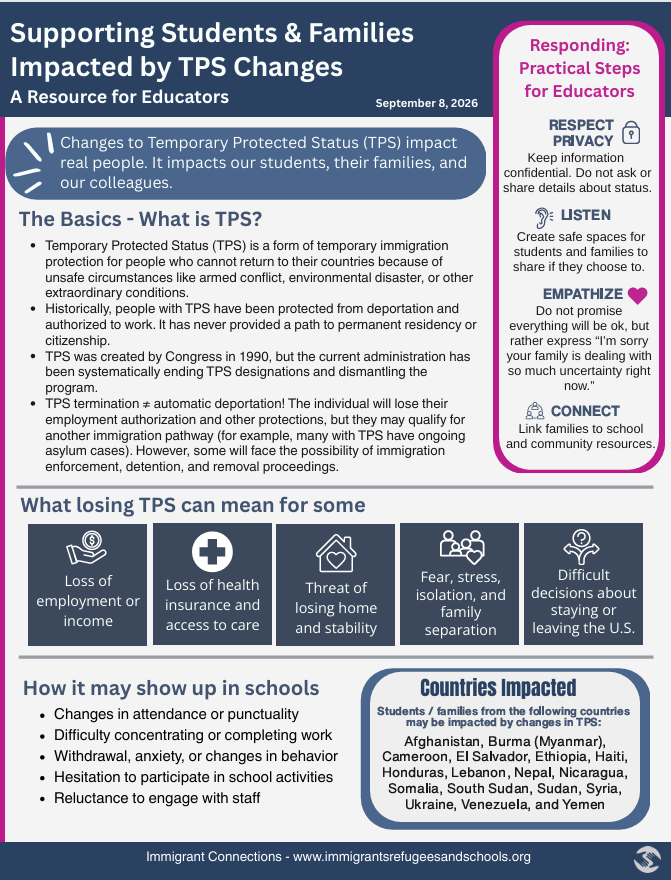
This 2-page overview from Immigrant Connections includes information about:
- what Temporary Protected Status (TPS) is
- what losing TPS can mean for some
- how changes related to TPS may show up in schools
- the countries impacted
It also includes three case examples and reflection questions. This resource was created in collaboration with a team that included an immigration lawyer, school counselor, social worker, and EL educator.
Examples from the Field
One district that serves a large number families who have TPS has held (and will hold some more this fall) Family Preparedness workshops so that parents can create a Caregiver Affidavit. With this step, in case parents are detained, there are plans in place to make educational decisions about their children. Notary publics are part of the workshops.
See more:
- How is the death of Pierre Damas Bel resonating with Ohio’s Haitian community? (NPR)
- ‘Bring them to school’: Superintendent encourages Haitians to return amid TPS fears (Miami Herald)
- Orange County Public Schools loses nearly 50 employees after TPS ruling (WFTV)
- What's next for immigrants with TPS after Supreme Court ruling? (PBS News Hour)






Add new comment