
What gave you the idea for this book and when did you start writing it?
I was an elementary school librarian in a diverse school in Falls Church, Virginia, approximately ten miles from the Pentagon. On the first anniversary of the terrorist attack, our school held a short memorial program through our in-house television program. In following years, there was no school-wide observance. I observed the anniversary in my library classes, reading books like Mordecai Gerstein’s The Man Who Walked Between The Towers or Maira Kalman’s Fireboat: The Heroic Adventures of the John J. Harvey. But I did not have resources to make this story personal to students living in Northern Virginia. For them, it was something that happened far away in New York City. During a conversation with a group of sixth graders in 2008, I saw honest surprise on young faces as I told them the Pentagon had been part of the 9/11 terrorist attacks. This worried me. If students living ten miles from the Pentagon didn’t know, it was even less likely that students in Arizona or Florida did. One hundred and eighty-four innocent people died when American Airlines Flight 77 crashed into the Pentagon. I did not want the lives lost there to be overlooked or the experience of those who witnessed this event in Arlington to be ignored.
I decided to write a book about the events of 9/11 in Northern Virginia after several years of discussing my feelings with educators and friends. One day in the summer of 2019, a fellow author said to me, "You are passionate about this. You should write a book." With this encouragement, I began.
Why did you choose poetry as the format?
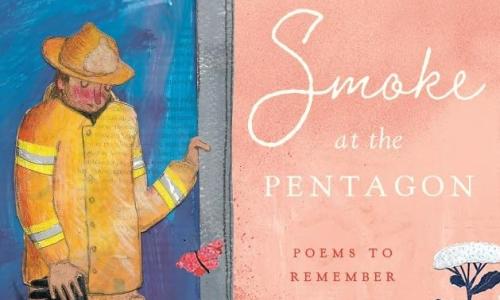
It was important to me to include reactions from young people of all ages. There were kindergarteners on the playground in Alexandria who heard the terrifying boom of the plane crash. Children waited in confusion at elementary schools, seeing one classmate after another picked up. There were high schoolers, my own teenage son included, who watched the cancellations on the television that day and exclaimed, "The whole world has stopped." A five-year-old does not understand in the same way as a sixteen-year-old. Narrative poetry, in which a single story appears on a page, gave me the opportunity to share many different perceptions. Each page of Smoke at the Pentagon: Poems to Remember begins with the first name of a young person, followed by their age.
What are some of the diverse perspectives you include?
Karima, age 13, recalls staying home from school for a couple of days after 9/11 because her Muslim parents thought she would be safer "away from angry people who might accuse me of something totally foreign to my family, to the way we believe, to who we are." While Karima's classmate, Jennifer, is worried about Karima after hearing a brick was hurled through a store window with an Arabic sign, Jennifer hopes Karima will return to school so she will have the chance to say, "our world doesn’t need any more broken glass."
Jaime, age 15, describes flying out of Reagan airport to attend his cousin's wedding, even though other relatives like his Tía Carmen cancelled, because she can't imagine flying again. Jaime observes the long security lines and the passengers eyeing each other with suspicion. He realizes airports will never be the same.
Tayvon, age 11, stands on the porch with his father, watching the smoke from the Pentagon rise in the distance. He inhales the bad smell, scared "the whole sky will be swallowed."
Reuben, age 10, joins a community potluck to comfort a neighbor who lost her husband in the crash. Reuben says it's like International Night at school with people bringing foods from different countries. Except there is "no dancing, no music, more tears than smiles."
What kind of research did you do?
In addition to reading articles and watching a documentary available through the Arlington County Library, I asked people to share memories. Anyone who wasn't a small child in 2001 can tell you what they were doing and feeling on September 11th. It was the main topic of conversation at Arlington gatherings for months and months. I included as many shared memories into the poems as I could.
How did your personal experiences shape the book?
I wove my own memories and memories shared with me into each and every poem. My own memories of that day and the aftermath shaped many poems in the book. Josselyn, age 14, describes shopping at a crowded grocery store with "all these people buying too much stuff because something else might happen." Shopping that afternoon is still a strong memory for me. The store was packed but eerily silent.
In another poem, sixteen-year-old Calista doesn't know what to say when the little boy she is babysitting tells her "The Pentagon is broken. I saw the hole from my daddy’s car." This happened to me as a teacher. One of my preschool students insisted on whispering this information in my ear.
At the time, I had teenage children and their friends in my life. We talked about 9/11 and their feelings. In fact, I came home to a houseful of teenage boys that day. (I had a pool table in my basement and I was located near the high school. My house was a hangout.) Several stories in the book were drawn from things my son and his friends told me.
How did your experiences as an educator shape the book?
My students at the time were elementary and preschool. Discussing the subject if they didn't bring it up was not appropriate in my role as teacher. I remember being cautioned not to frighten young children and to let parents explain at home. However, some kids, like the little boy who whispered in my ear that the Pentagon was broken, brought the topic up themselves.
I wrote the book for my own students in Northern Virginia and for succeeding generations of students. By the seventh anniversary, the students I was teaching had little knowledge of September 11th. Most were too young to remember. Others had not been living in the United States at the time of the terrorist attacks. They felt no connection to the event. I believe this history is important not only to honor the lives lost but to honor the resiliency of Arlington, Virginia. Within a year, the massive hole in the Pentagon, visible from the highway, was repaired.
Tyra, age 14, watches the construction from her school bus in the year after her mother died from cancer. She says, "Seeing that building reborn bit by bit helps me believe that one day I won't feel so broken, either."
Terrible, life-changing events happen to individuals and to communities. History recalls more than tragedy. It recalls how people rebuilt and continued after adversity. In the precarious world we live in, plagued by war, weather disasters, and countless other problems, the knowledge that we, as a country, have survived upheaval before is essential. It offers hope to students worried about the future.
How can teachers use this book?
Smoke at the Pentagon: Poems to Remember has 20 narrative poems and an introduction easily broken into speaking parts. It could be performed as Reader's Theater for a meaningful lesson remembering 9/11 on this important anniversary. Other teacher tips are available in a teacher's guide available on my website and the publisher's website.
Is there a particular poem you’d like to highlight?
Near the end of the book, two older narrators share their perspectives. Allison, age 21, describes visiting the Pentagon memorial and noting that she is honoring lives lost "in the city where I live, not somewhere else, far away." Nelson, age 18, discusses how 9/11 are the same numbers used for emergencies and how "those numbers mark a day thousands rushed to rescue others." The story of September 11th involves more than tragedy and destruction, it is a story of people coming to the aid of others, comforting each other, and vowing to rebuild.
Tell us about the illustrations.
Eszter Anna Rácz created striking and emotional illustrations for Smoke at the Pentagon. I especially appreciate how she blended pink, red, and brown. These warm colors evoked the right tone for the book.
Why did you feel it was important to capture this part of the 9/11 story?
The Pentagon is the headquarters of the U.S. Military. An attack on the Pentagon is both significant and symbolic. As Emily, age 13, says in the first poem of Smoke at the Pentagon, "If the Pentagon isn’t safe, no place is."
Yet many people have forgotten that the Pentagon was part of the September 11th attacks. Many people who live in Arlington and the surrounding area don’t even know there is a beautiful memorial on the grounds of the Pentagon. Smoke at the Pentagon; Poems to Remember is the only book which gives voice to the experience of being in Northern Virginia in 2001.




Add new comment