
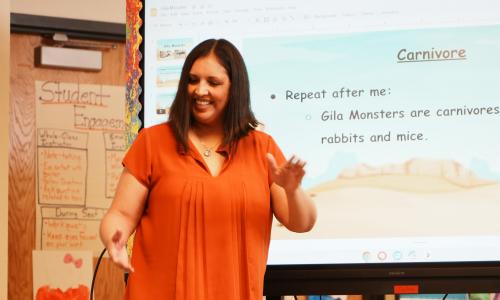
Vocabulary plays an important part in learning to read, as well as in understanding what is read. Here are some ideas to make the most of your vocabulary instruction for English language learners (ELLs) within literacy lessons.
For additional ideas focused on content-area instruction, see our Teaching Vocabulary strategy in the ELL Strategy Library.
Note: Special thanks to contributors Kristina Robertson and Dr. Karen Ford. This article also includes multimedia resources from Reading Universe, a new sister project of Colorín Colorado.
Vocabulary and Phonics Instruction
Why It Matters
As ELLs learn to decode, it's important to use familiar vocabulary in their phonics instruction. Otherwise, it will be hard for them to figure out words that they don't recognize as they read them aloud. Students need to be familiar not only with the sounds and letters they are learning but also the words in which they appear.
Keep in mind that ELLs often show many strengths in mastering early phonics skills, but decoding and correctly spelling words does not ensure comprehension. The authors of Words Their Way with English Learners write, "English learners need structured opportunities to learn many new words to add to their repertoires so that these words can become the material of their literacy learning" (2011, p. 79).
Dr. Claude Goldenberg suggests the following:
Teach students the words you'll use to teach and illustrate foundational skills. For instance, when using pictures or objects to represent a letter name or sound (like octopus for the short 'o' sound), make sure your ELs can pronounce the words and understand their meaning.
Classroom Strategies
- Use familiar vocabulary in phonics instruction and decoding practice.
- Pre-teach words used for phonics practice so that ELLs understand the words that they are learning to decode.
- Give students opportunities for both speaking and listening in phonics instruction through games and partner activities.
- Have students search for the words and phonics features they are learning in the texts they read.
Your Literacy Curriculum
If you are using a literacy curriculum or program, it may include materials designed to reinforce or review target vocabulary, such as:
- Word lists
- Vocabulary activities
- Writing tasks
- Text passages
ELL expert Beth Skelton notes that often these materials appear at the end of a unit as a review, culminating, or bonus activity, but they can also be used at the beginning of a new lesson or unit to help students get familiar with the language they will be using to practice targeted skills. (Personal communication, 2024)
The short "u"
In this podcast interview, Dr. Francesca Smith recalls teaching an early literacy lesson about the short "u" sound. The story centered around a tub. The student's English was fairly proficient, and after the lesson was complete, Dr. Smith was surprised when he asked what a tub was. She reflects on how reviewing the key vocabulary in the story beforehand might have improved his comprehension of the story.
Videos: Vocabulary Instruction in Action
Take a look at vocabulary instruction embedded within a classroom literacy lesson in this video featuring ELL expert Dr. Elsa Cárdenas-Hagan and Leonor Delgado, a veteran teacher at P.S. 109 in the Bronx. This video was produced by our sister site, Reading Universe.
Teaching New Vocabulary
Why It Matters
Understanding vocabulary words is a key step in reading comprehension. The more words a student knows, the better he or she will understand the text.
ELLs need direct instruction for new vocabulary words, as well as multiple opportunities to use the words. It is important to give students as much exposure and experience with new vocabulary words as possible in preparation for a lesson or activity.
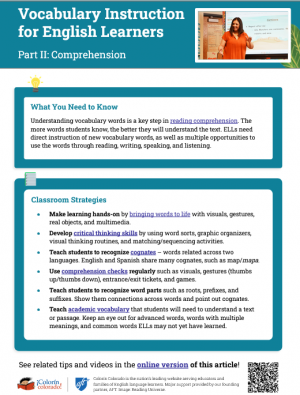
Classroom Strategies
One helpful way to think about vocabulary instruction is STAR:
- Select
- Teach
- Apply
- Review
Select Vocabulary
Select words that will support the reader's understanding of the story or text, as well as other phrases and connectors that affect comprehension. Rather than highlighting the most unique or unusual words, try to focus on words that students may also come across in other contexts, what Dr. Nonie Lesaux calls “high-utility words.”
Teach Vocabulary
Teach vocabulary with tools such as:
- Role playing
- Visuals, such as pictures, videos, real objects, and gestures
- Student-friendly definition
- Graphic organizers
You can draw upon students' home languages to build vocabulary by:
- Providing multilingual glossaries with definitions of vocabulary words
- Giving students the opportunity to discuss word meanings with peers who speak the home language
- Asking students how to say a word in their language and sharing it with the class
- Teaching students to recognize cognates (words related in two languages)
Apply Vocabulary
After you introduce new words, students need to practice these words through different language skills: reading, writing, speaking, and listening. Students need to see and use a word several times to learn it.
To reinforce vocabulary, ask students to:
- Highlight the target words in the text
- Listen for the words in a read-aloud or audio recording
- Write sample sentences with the target words
- Use the target words in discussion
Review Vocabulary
You can review vocabulary through all kinds of fun activities. Here are just a few from our ELL Strategy Library:
- Comprehension Checks: Quick, real-time checks on students' understanding
- Match, Sort, and Order: Activities that focus on matching, organizing, and sequencing
- Photo Gallery: A matching activity in which multiple options are possible and students must explain their matches
- Concept Maps: Graphic organizers that allow students to organize key words and concepts
- Picture Word Inductive Model: An activity in which students write sentences using key vocabulary and language structures based on visuals
- Picture Retell: An activity in which students retell a narrative story or key points of an informative text using pictures from the text as a support
Strategy Focus: Cognates
- Cognates are words in different languages that are derived from the same original word or root. About 40% of all English words have cognates in Spanish (such as the English/Spanish cognate "family/familia”). This is an obvious bridge to the English language for Spanish speakers if the student is made aware of how to use this resource.
- Teach students to recognize and use cognates, or words that are related across languages, and encourage students to be on the lookout for cognates from other languages as well.
- Ask students to compare sounds, syllables, spelling, pronunciation, and meaning across cognates. What's the same? What's different? You can see this instruction in practice in Dr. Elsa Cárdenas-Hagan's "One-on-One with an English Learner" video below.
- Keep in mind that there may also be some false cognates as well! Some examples in Spanish include embarazada (pregnant), asistir (attend), éxito (success), ropa (clothes), and sopa (soup, not soap).
Videos: Cognates
In these video excerpts, learn more about cognates from ELL expert Dr. Elsa Cárdenas-Hagan. These videos were produced by our sister site, Reading Universe.
Teaching Academic Vocabulary
Why It Matters
As students learn to read more advanced texts, they must learn the meaning of new words that are not part of their oral vocabulary. For ELLs, vocabulary development is especially important as students' develop academic language. This word knowledge allows students to comprehend text, including the text found in content-area textbooks, on assessments, and in printed material. Without a strong foundation of academic vocabulary, ELLs won't be able to access the material they are expected to master.
Dr. Coleen D. Carlson writes,
For EL students, drawing attention to unknown words during the initial presentation of the text, providing appropriate levels of definitions (e.g., providing English labels for words for which concepts and labels in one’s native language are understood, quick definitions or demonstrations for simple words) and tying to background knowledge are critical. No amount of simply reading and rereading words will produce knowledge of unknown vocabulary. (2020, p. 97)
Classroom Strategies
Mastering Academic Vocabulary
The STAR approach will work well for academic vocabulary as well:
- Select key academic words in text that you will be using. Think about what words the students will need to understand the text, content, or activities in your lesson.
- Teach academic vocabulary with the strategies listed above. Look for ways to make learning hands-on and to make connections with students' background knowledge.
- Apply academic vocabulary through ample practice in reading, writing, speaking, and listening.
- Review academic vocabulary through games and activities that offer additional practice for word mastery.
Using Sentence Frames
Teach common structures and terms used in a specific content area. For example, sentence frames are a great way to get students familiar with these structures and can be used in writing and speaking:
- The _____ is ______ than the _____.
- I can conclude ______ because _______.
Getting Student Input
You can learn a lot from students by asking them what helps them learn new words and what their favorite vocabulary activities are. Their input can help you plan instruction and support student engagement.
Professional Learning
Colorín Colorado has prepared a slide deck about vocabulary for ELLs that can be used for turnkey professional development sessions. It features several videos and activities for professional learning. Please share attribution to Colorin Colorado.
To get started, you need:
- Vocabulary Instruction for ELLs Slide Deck: Includes activities, discussion questions, and videos (also featured below)
To edit this presentation, you can download or copy the slides:
- File > Download (no Google account required)
- File > Make a copy (Google account required)













Add new comment