

One of the many ways that educators can use Artificial Intelligence (AI) is to create instructional materials for their students. These materials might include lesson plans, background readings, quizzes, visuals, multimedia resources, and much more.
To create these kinds of materials, a user must:
- Choose an AI tool
- Give the tool instructions about what they wish to create
These instructions are called "prompts" — they are the commands telling the AI tool what to do.
Writing AI prompts is both an art and a science. It takes practice, as well as trial and error. The more specific your prompts are, the more tailored your results will be. What differences do you notice between these two prompts?
Prompt #1
Create a short paragraph about the history of the Statue of Liberty for elementary students.
Prompt #2
Create a short paragraph about the history of the Statue of Liberty for a fourth-grade Social Studies class. Include information about the origins of the statue, its construction, and the materials it is made of. Highlight key vocabulary terms in bold and include 3-5 comprehension questions at the end.
Writing Prompts for ELLs
GLASSES Tool for ELLs
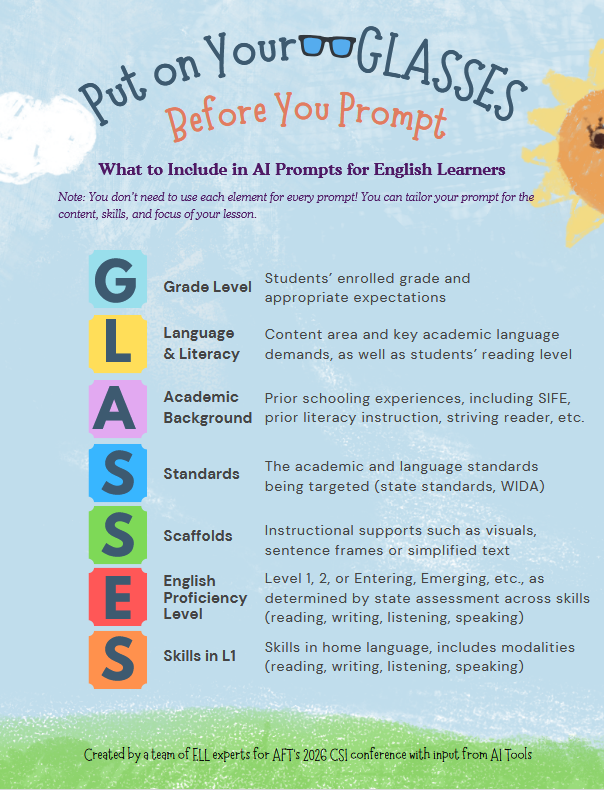
When you create AI-generated materials to use with English language learners (ELLs), there are many ways to incorporate ELL considerations into your prompts. These can include specific scaffolds, language proficiency levels, the students' home languages, and standards you may wish to include.
Put On Your GLASSES!
The acronym GLASSES can help you remember what to include — as in, it’s time to put on your GLASSES! Not only does the acronym highlight key ELL considerations, but it’s also a reminder to center students and look at our instruction through an ELL lens, including when using AI. You can use these considerations when using:
- Large Language Models (ChatGPT, ClaudeAI, Co-Pilot, and Gemini)
- Lesson planning tools, such as Diffit or Magic School
- Your own chatbot/agent that includes specific parameters and inputs
This acronym came about in preparation for a session about AI and ELLs at a conference hosted by AFT. Our team (Maria Elena, Susan, and Lydia) decided to create a tool that would support educators in writing prompts for ELLs. We started throwing around ideas about an acronym and then Maria Elena put our question into ChatGPT, which yielded a promising, if clunky, option. We refined it, drawing upon our combined expertise and turning it into something more memorable. Susan then used Canva for help with an eye-catching visual. Voila! AI helped — and our expertise made it better. You could try a similar process if you wish to refine or edit this tool (or another) as well.
Let’s take a closer look at GLASSES:
- Grade Level
- Language
- Academic Background
- Standards
- Scaffolds
- English Language Proficiency Level
- Skills in L1
Here is more detail about what those considerations could involve. Keep in mind the following:
- These elements and descriptions are a starting point that you can tailor for the lessons or materials you wish to create.
- You don't need to use every element of this list in every prompt.
- You may wish to target specific areas for a particular lesson.
- You might use different elements of these with AI tools that focus on a particular task, such as a vocabulary list generator, translation, or a text leveler.
- There are multiple ways to address students' reading levels.
- You can pull in other guiding resources, such as uploading language proficiency standards or linking to strategies from Colorin Colorado's ELL Strategy Library.
- You can also create your own template, form, or chatbot that includes key criteria, as seen in this example from the English Language Acquisition Department at Leysin American School in Switzerland — thanks to Aaron Deupree, Mari McCarville, and Jenna Skove!
| Lesson Element | Description |
|---|---|
| Grade Level | Students' enrolled grade and appropriate expectations |
| Language & Literacy | The content area and key academic language demands, as well as students' reading level |
| Academic Background | Prior schooling experiences, including interrupted education or literacy, interrupted literacy, limited prior reading instruction, or strong literacy in prior schooling |
| Standards | The academic and language standards being targeted (state standards, WIDA) |
| Scaffolds | Instructional supports such as visuals, sentence frames, cognates, or simplified text |
| English Language Proficiency Level | Level 1, 2, or Entering, Emerging, etc., as determined by state assessment for different language skills (reading, writing, listening, speaking) |
| Skills in L1 | Skills in home language, includes modalities (reading, writing, listening, speaking) |
You can download this template in Word and adjust as needed.
Sample Lesson Plans: Statue of Liberty
Now let’s see what this might look like with our example from above about the Statue of Liberty.
| Lesson Element | Description | Statue of Liberty Lesson |
|---|---|---|
| Grade Level | Students' enrolled grade and appropriate expectations | 4th grade |
| Language & Literacy | The content area and key academic language demands, as well as students' reading level | Background information about Statue of Liberty, including history, construction, and materials for students at a 4th-grade reading level |
| Academic Background | Prior schooling experiences, including interrupted education or literacy, interrupted literacy, limited prior reading instruction, or strong literacy in prior schooling | Students with prior schooling |
| Standards | The academic and language standards being targeted (state standards, WIDA) | WIDA Standards and New York State Social Studies standards |
| Scaffolds | Instructional supports such as visuals, sentence frames, cognates, or simplified text | Vocabulary list with definitions, cognates, and comprehension questions |
| English Language Proficiency Level | Level 1, 2, or Entering, Emerging, etc., as determined by state assessment for different language skills (reading, writing, listening, speaking) | Emerging proficiency level |
| Skills in L1 | Skills in home language, includes modalities (reading, writing, listening, speaking) | Students are literate in Spanish |
Lesson: Social Studies
When you put this all into a single prompt, it might look something like this:
Create a Grade 4 Social Studies text aligned to the New York State social studies standards and WIDA standards about the history of the Statue of Liberty. Include information about the origins of the statue, its construction, and the materials it is made of. Design the lesson for English Learners at the Emerging levels of English proficiency. Include scaffolds such as visuals, vocabulary lists with definitions, and English-Spanish cognates. Leverage students’ literacy skills in Spanish through bilingual vocabulary supports. Highlight key vocabulary terms in bold and include 3-5 comprehension questions at the end.
To see a sample lesson plan generated by this prompt, see this example:
- Statue of Liberty: A Symbol of Freedom (ClaudeAI)
Lesson: Language Arts
For additional ideas, see the following prompts on "The New Colossus," the poem displayed on the base of the Statue of Liberty:
Provide a scaffolded reading guide for Emma Lazarus' poem "The New Colossus" for a 9th-grade ELA class. Include background information, vocabulary words with definitions, partner questions for discussion, and brief comprehension questions. Provide this guide in English and Spanish.
Sample lesson plans:
You can also incorporate other strategies, such as our text engineering strategy from the ELL Strategy Library. Here is a sample, also featuring "The New Colossus."
Using Colorin Colorado's text engineering strategy, scaffold the text of "The New Colossus" for Spanish-speaking English learners at a 5th-grade reading level. Include user-friendly definitions, synonyms, and cognates.
Sample lesson plan:
- "The New Colossus" with Text Engineering (ClaudeAI)
Lesson: Science
Finally, we created an example for high school chemistry looking at the question of why the Statue of Liberty is green. Using MagicSchool's 5E science tool, we entered the following prompt:
Develop a 10th-grade chemistry lesson plan about the Statue of Liberty's color and the chemical changes to the copper skin over time for English language learners with Advanced English proficiency. Include scaffolds such as sentence starters, graphic organizers, word banks, and multilingual glossaries in English and Haitian Creole.
Sample lesson plan:
- The Statue of Liberty's Color: Chemistry Lesson (MagicShool AI)





Add new comment