

Front office staff, including school registrars, secretaries, and administrative assistants, play a critical role in welcoming and registering families, as well as providing ongoing logistical support and information throughout the year. Here are steps that front office staff can take to support and partner with English language learners (ELLs) and ELL families.
Tips for Front Office Staff

Welcoming students and families
You may be one of the first individuals families interact with in their child's school.
- Welcome families with a smile and warm greeting.
- Post welcome signs in their languages.
- Introduce yourself and show families where your desk or office is located.
- Post a sign in families' languages with your name and how you can help.
- Let them know where to ask questions.
Visiting the front office
- Encourage colleagues to include the front office on school tours for students and families.
- If needed, show families where the front office is located and where to enter the school.
- Inform families of any rules or procedures related to entering the school, including which door to use, required identification, and other safety rules.
Providing language access
All families have a legal right to information from the school in their home language.
- Find out what language support resources your district has (e.g., interpreters, language lines, and translation of documents).
- Learn about your school or district protocols for providing language assistance to families, such as whom to contact for support, how far in advance translation requests need to be submitted, and how interpreters' schedules work. (Students should never be used as interpreters for enrollment or front office procedures.)
- If additional support is needed in your setting, bring specific questions and suggestions to your administrator. ELL and bilingual colleagues may also have ideas to support multilingual communication.
Translation apps
Translation apps can fill in gaps where needed. Your school may already be using an app like this with families.
Translation apps are best for quick questions, reminders, and straightforward issues. They are not appropriate for complex or sensitive communication — and they are not perfect. They also can't take cultural considerations into account the way that bilingual, bicultural staff members can. While translation apps are becoming more accurate and offer a good starting place, it's important to advocate for long-term, people-centered solutions related to language access.
Managing student enrollment
If you are responsible for registering students, there are some important things you need to know:
- Find out what kinds of documents are required for enrollment in your school district, such as residency requirements. These documents should not be related to, or ask any information about, students' or families' immigration status.
- Provide a list of translated enrollment instructions and requirements in families' languages.
- Identify procedures for connecting ELLs and their families with important contacts, such as ESL teachers, family liaisons, and classroom teachers.
- Your school may use a home language questionnaire. If so, find out how it is used and instructions for filling it out.
Getting students' names right
Misspelling students' names in school databases can impact the services and instruction a student receives, especially if the name is entered multiple times and/or misspelled in different places. In addition, misspelling a name may further complicate students' efforts to register for activities and programs — especially as they get closer to graduation and college applications.
- Verify the spelling of students' names with students and/or families, working with an interpreter if needed. If families have low levels of literacy, find out if any other documents are available that include the student's name.
- Check that students' names are written correctly across school records and student databases and that there aren't multiple entries for one student.
- Children may have multiple given names, and naming conventions in your families' cultures and languages may be different than in the U.S. Be sure to clarify students' first and last names.
- Parents may spell names differently, such as Estefany, Jhonny, and Yessica. Use students' names exactly as they're spelled and refrain from correcting families or students, or changing the spelling.
- Students may also prefer to use a nickname or middle name. Include a space for the student's preferred name on registration form, and point out that information to teachers.
Getting It Right: Reference Guides for Registering Students With Non-English Names
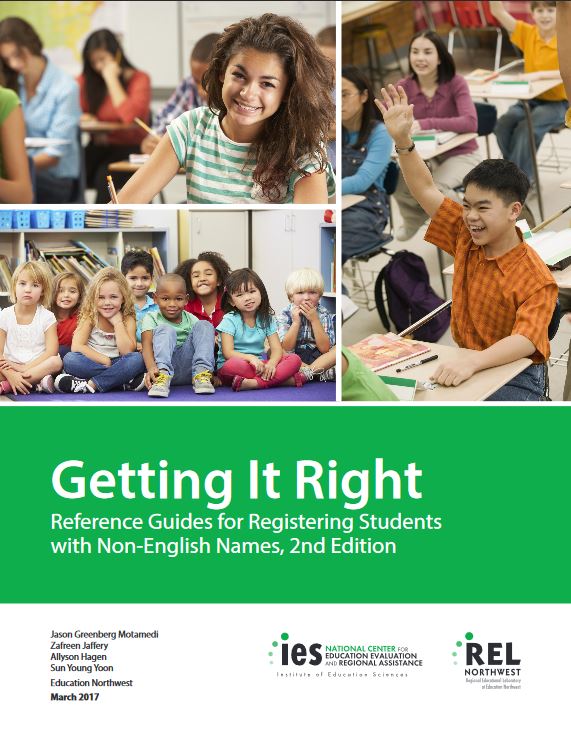 This set of naming conventions guides from IES and REL Northwest can serve as a reference for accurately and consistently entering students' names in school, district, and state databases, as well as addressing and greeting parents and other family members in a culturally responsive and respectful way. The guides are available for students with home languages of Arabic, Chinese, Hindi, Korean, Russian, Somali, Spanish, Tagalog, Ukrainian, Urdu, and Vietnamese.
Navigating daily routines
You can play an important role in helping families understand daily routines, either by explaining these policies or working with colleagues to provide multilingual information on topics such as:
- Arrival
- Dismissal
- Early release
- Picking a child up early
- Inclement weather policies
- Setting up meetings with school leaders, teachers, or staff
Provide instructions in families' languages on these important procedures.
If you notice that there is a problem or confusion, bring the issue to a supervisor immediately. Students or families may need more information or reminders in their language about specific policies.
Note: Families from warmer climates may be unaccustomed to winter weather. Learn more in 15 Strategies for Communicating with ELL Families During the Winter.
Knowing immigrant students' rights
All students have a right to a free public K-12 education, regardless of their (or their parents') immigration status. Documents related to immigration or immigrant status should not be requested by the school.
In addition, it's important to know what steps to take if law or immigration enforcement visits the school. Ask administrators for legal guidance and training on:
- Student privacy
- Interactions with law enforcement
- Interactions with immigration enforcement
Collaborating with colleagues
The front office is a hub for the entire school, with students, families, administrators, staff, educators, counselors, and visitors passing through. Reach out to colleagues who work closely with ELLs and ELL families, such as family liaisons, bilingual teachers, and ESL specialists to identify key areas where you can work together.
Staff members who will work with ELLs will play different roles and have different skills. These are some of the staff who work most closely with ELLs and ELL families:
- Family liaisons work very closely with families around a wide range of issues that may include enrollment, academic support, social and emotional support, and services related to basic needs. In some cases, certain staff members may specialize in academic issues, while a social worker or family advocate focuses on basic needs and social services.
- Interpreters are trained and certified to provide spoken translation. In some cases, interpreters may also be certified to provide written translation, although other teams may be responsible for translating documents.
- Bilingual educators are trained to provide instruction in two languages, or to work within a bilingual setting. They may be bilingual themselves and are experts on bilingualism.
- ELL educators are experts in language development. ELL educators often are very familiar with the systems that support ELL students. They also may be addressing basic needs and social services.
- Paraprofessionals often provide academic support and social and emotional support. They may also work closely with families.
Note:
- Bilingual staff members are not necessarily trained as interpreters and should not be pulled from other duties to interpret. Learn more about the differences between interpreters and bilingual staff in this related chart.
- If you are a bilingual staff member, talk with a supervisor about establishing guidelines for communication with families so that there is a process in place for helping families with language assistance as needed. That may be part of your role in the front office, but if it is regularly interrupting other duties, it may be helpful to look for another solution.
Tips for ELL and Bilingual Staff
Introduce yourself to front office staff
If you are new to your school or new front office staff have joined the school community, take some time to introduce yourself and share your role. Let them know you are available to help with questions. While you may not want to jump into a lot of details at once, it may be worth following up or checking in once the school year starts.
Find out how school registration works
The better you understand the school registration process, the better you can support families. Ask front office staff to walk you through the process. Find out what information they have about required documents for registration and about serving ELLs and immigrant students.
Collaborate on how to best support ELL families
If you notice that certain questions or topics come up regularly with ELL families that involve registration or school logistics, approach the front office staff with the issue. They may be able to come up with a straightforward solution, or you might be able to work together to share ideas.
Tips for Administrators
Provide front office staff with training
Ensure front office staff have appropriate training on key ELL topics, such as:
- Enrollment procedures (including which documents are required)
- Communicating with multilingual families
- Bilingual staff members' responsibilities and schedules
- Attendance policies
- Immigrant students' rights
- Interacting with law and immigration enforcement
Keep in mind that your front office staff may be the primary point of contact for families, visitors to the school, and law enforcement.
Check in with front office staff regularly
Check in with staff in the front office to see what's working, what's not working, and where changes might be needed. They will have their ear to the ground and a good sense of how things are working for families on a daily basis.
Explore different support options to support enrollment
You may wish to look for ways to centralize or streamline enrollment procedures for new ELL families, including newcomers who need additional support. This might include:
- Creating an enrollment center
- Hiring a bilingual registrar
- Providing summer support for enrollment
There may be different types of funds available to support these efforts. For example, in Cincinnati Public Schools, the district uses Title III funds to employ a team of bilingual faculty and staff who provide family support during the summer. The team helps families with school enrollment and signing up for bus transportation, and they also help families learn more about the school system.
Ideas for Classroom Teachers
- Invite front office staff to your classroom to meet students. Ask them to explain what they do.
- Show your appreciation for front office staff through thank-you notes or kind gestures during the year.
- Keep in mind that front office staff can play an important role as a friendly face in the school.
Professional Learning Sessions
What You Need to Know
- This Colorín Colorado slide deck can be used for turnkey professional development sessions. Please share attribution to Colorín Colorado.
- We recommend customizing these sessions with screenshots of related platforms, policies, or resources from your setting.
- While the target audience of this slide deck is front office staff, we also recommend inviting other staff to attend training sessions where this slide deck is used such as family liaisons, ELL educators, and administrators. This can create an opportunity for a productive, collaborative conversation on family enrollment and engagement.
To get started, you need the slide deck below, which includes activities, discussion questions, and speaker's notes.
To edit this presentation, you can download or copy the slides:
- File > Download (no Google account required)
- File > Make a copy (Google account required)









Add new comment