

If you teach English language learners (ELLs), there are a lot of steps you can take early on to support your students' success. These tips, shared by veteran ELL educators, offer practical ideas that you can use right away, whether you are new to teaching ELLs, starting a new school year, or welcoming newcomers. Additional ideas are offered in the featured videos at the end of the article.
Coming soon!
These tips will also be available in a PDF format and slide deck that you are welcome to share.
If you are new to teaching English language learners (ELLs), you may be wondering how best to communicate with your students. Here are some tips to help you get started!
Communicating with ELLs
1. Speak clearly.
Keep your language clear. Speak calmly and try to avoid slang and idioms when possible, such as "We're going to hit the ground running." While you don't necessarily need to speak more slowly or loudly, be mindful of your speech; you may need to adjust it slightly to support student understanding.
In addition, repeat information and review frequently. If a student doesn't understand, try rephrasing or paraphrasing in shorter sentences and simpler syntax.
2. Support understanding with visuals and gestures.
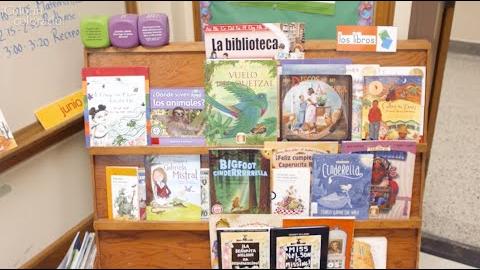
Use visuals and gestures to help support student understanding; these might include pictures, signs, and cues that support content learning as well as classroom routines, such as a harmonica note that signals that it's time to focus on the teacher.
3. Use comprehension checks.
Comprehension checsk are quick check-ins that assess student understanding, such as thumbs up, holding up fingers, emojis, exit tickets, or open-ended questions. These are more effective than asking students, "Do you understand?"
4. Use translation tools strategically.
Translation tools can be helpful in the early days; find out if your school has an approved tool that you are allowed to use with students. Translation tools can support student and communication in many ways, but it is also possible for teachers and students alike to over-rely on them.
5. Post a classroom schedule with visuals.
Post a schedule with visuals and give students a copy, ideally in their language. Share classroom expectations for daily activities. This is particularly important if students have had limited schooling and are "new" to school. Having a schedule to refer to can help students get their bearings.
6. Keep an eye out for the "silent period."
Keep in mind that students who are learning a new language may go through a "silent period" in which they are listening and learning. In addition, keep in mind that students' silence could also be a sign of respect for you as an authority – and not a sign of their inability or refusal to participate.Students may not speak much during this time as they absorb new language.
However, you can support their language use with scaffolds such as sentence frames, peer learning discussion in students' languages, and multilingual glossaries. Be patient and look for opportunities for small successes in speaking with you and peers, which can help build students' confidence.
Related Videos
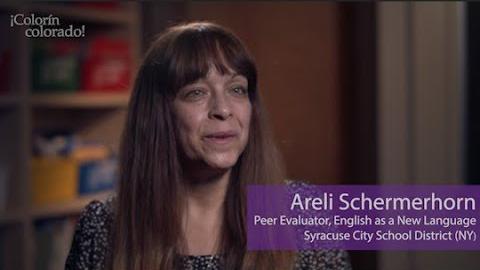
Learn more about the "silent period" in these two videos. The first is an excerpt from Dr. Elsa Cardenas-Hagan's presentation on teaching ELLs to read. The second features ELL expert Areli Schermerhorn, who remembers her experiences as an English learner.
ELL Instruction
There are lots of ways to support ELL instruction! Here are few high-impact strategies to help you get started, with links to more information about how to use each strategy.
7. Identify important background knowledge.
Keep an eye out for the background knowledge students will need to support their learning. Look for ways to connect content to students' experiences and find out what students know about a topic. Build new knowledge where needed.
8. Support instruction with scaffolds.
Scaffolds are temporary supports that give students access to grade-level content. Just like the scaffolds used in building construction, scaffolds are taken away when they are no longer needed.
Use scaffolds such as:
- Visuals
- Graphic organizers
- Realia and manipulatives
- Sentence frames
- Translated texts
Find more tips on how to use these scaffolds from our ELL Strategy Library.
9. Teach key vocabulary.
Teach key vocabulary, such as:
- Academic words (helium)
- Words with multiple meanings (yard)
- Homophones (flower/flour)
- Common words used in a lesson or text (train station)
10. Use students' languages to support instruction.
Students' languages are a valuable asset! You don't need to speak students' languages in order to use them to support instruction. You can use:
- Multilingual glossaries: Glossaries that include terms and definitions in English and students' languages. They may also include visuals, sample sentences, sentence frames, and partner discussion questions.
- Cognates are related words in two languages (e.g., the English-Spanish pair information/información). Many languages share cognates with English, including Spanish, which is the most common language spoken among ELLs in the U.S. Teach students how to recognize cognates.
11. Incorporate peer learning into your routines.
Look for ways to that students' can interact with their peers in pairs or small groups on a regular basis to give them plenty of speaking and listening practice. Use a variety of groupings; for example, during a brainstorming activity, you may wish to pair students who speak the same language so that they can compile many ideas and share a summary of their brainstorm in English. For a group project, you may wish to assign students with different proficiency levels together.
12. Try only one new thing at a time.
ELL expert Kristina Robertson reminds teachers that teaching multiple new things at the same time often doesn't work! When introducing new material, remember the following:
- If you are teaching new language, use familiar content.
- If you are teaching new content, use familiar language.
















Add new comment