Overview
Names are an important part of our identity. Getting students' names right is a sign of respect and an indication that students are welcome in the classroom. Alternatively, students whose names are mispronounced or changed also may feel hurt that their full identity is not recognized or celebrated in the classroom. They (and their families) may feel embarrassed, disrespected, or unwelcome. This can also happen to students whose names are changed or shortened for "convenience."
Here are some ideas you can use to get students' names right, along with related videos, activities, and discussion questions.
Classroom Tips
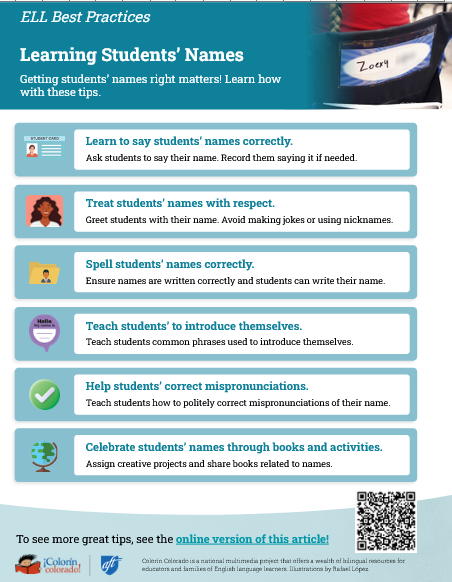
1. Learn to say students' names correctly.
- When you ask students to say their name, listen carefully and repeat it until you get it right.
- Ask students or family members to record themselves saying students' names so that you can hear their pronunciation. (You can ask them to send you a voice recording or use an online platform like NameCoach.)
- Share recordings with colleagues so that they also pronounce students' names correctly.
- Model the correct pronunciation of students' names to the class so that all students can say it correctly.
- Use students' names when greeting them each day.
Teacher Voices
Teacher Chris Homiak shared this activity with us:
Tried something new today: had students write their names phonetically, along with the way some teachers (in this first week) have been mispronouncing them. Recorded short videos on iPads, and practiced conversations of how to share with teachers.
I learned that I needed to fix my pronunciation on a few as well. So important to make space for getting this right. By middle school, many have given up and adopted different or shortened names. Many needed to be convinced of the right to expect correct name pronunciation.
And ELL expert Melissa Labossiere suggested the following:
Have students create a slide in a classroom slide deck with their picture, things they want others to know about themselves, and a recording of themselves saying their name. This way all students have access to the slides; teachers can re-listen to the names and share slides with colleagues; and students who enter the class at different times of the school year can have access as well.
Related Videos
Dr. Sonia Nieto talks about the importance of learning students' names and saying them correctly.
2. Find out which names students use and prefer.
It's important find out which name your students prefer. Perhaps they use a nickname or middle name. This information may be on their registration form, or you can also ask students or families about preferences.
ESL teacher Lydia De Jesus shares the story of a student who wouldn't respond when her name was called. When the teacher asked Ms. De Jesus why this might be the case, Ms. De Jesus suggested looking at the student's records. The parents had in fact noted that the student preferred to use her middle name — information the teacher hadn't noticed on the form.
3. Treat names respectfully.
Refrain from:
- Making jokes about students' names
- Coming up with a nickname that's easier for you to say
- "Americanizing" a name
- Shortening a student's name
In addition, make sure that your students are using names respectfully. If any bullying occurs, address it immediately.
Related Videos
Award-winning author Hena Khan talks about her own experiences with her name being mispronounced and how they inspired her middle grade novel, Amina's Voice.
4. Spell names correctly.
Misspelling students' names in school databases can impact the services and instruction a student receives, especially if the name is entered multiple times and/or misspelled in different places. In addition, misspelling a name may further complicate students' efforts to register for activities and programs — especially as they get closer to graduation and college applications.
- Verify the spelling of students' names with students and/or families, working with an interpreter and front office staff if needed. If families have low levels of literacy, find out if any other documents are available that include the student's name.
- Check that students' names are written correctly across school records and student databases and that there aren't multiple entries for one student.
- Ensure that students can write their own names, especially if they speak a language that has a different kind of writing system. Help students practice with fun games and activities.
- Children may have multiple given names, and naming conventions from your families' cultures and languages may be different than in the U.S. Be sure to clarify students' first and last names.
- Parents may spell names differently, such as Estefany, Jhonny, and Yessica. Use students' names exactly as they're spelled and refrain from correcting families or students, or changing the spelling.
Related Videos
Sylvia Acevedo, a technology executive and former president of the Girl Scouts, talks about why her name was shortened when she first went to school.
5. Teach students to introduce themselves.
- Teach phrases such as "My name is..." and "What is your name?"
- Model these phrases by saying and repeating them; providing related sentence frames; and providing a recording of these expressions that students can go back and listen to.
- Share translations of these phrases in students' languages in writing and/or through a language app.
6. Help students correct mispronunciations.
Many students will not correct an adult who mispronounces their name. You can empower your students by teaching them to politely correct others when they notice a mispronunciation or misspelling of their name. Giving them practice with this kind of activity will increase their confidence to use these skills in the future — skills they may need in setting beyond school and in adulthood.
- Ask students to share examples of how people mispronounce their name and how that makes them feel.
- Ask students what the benefits might be of learning how to politely correct others.
- Share examples of what students can say to correct mispronunciation, including sample phrases and sentence frames.
- Use role plays with different situations so that students get comfortable using your recommended phrases.
- Invite visitors to the classroom (such as another teacher) so students can practice with new people.
- Think of some sentence frames you could use to help students correct others who mispronounce their names.
- Develop a lesson plan that teaches students to correct others who misspell or mispronounce their name. Include learning objectives, key vocabulary, related sentence frames, and activities in which students can practice their new skills.
Note: Students may hesitate to correct adults, especially if it is considered disrespectful in their culture. If needed, talk with your colleagues who come from students' cultures to get some ideas for how to approach this topic. You may wish to speak directly with families to hear their concerns and share the goals for the activity.
Related Videos
In the first video, award-winning author Juana Martinez-Neal talks about the importance of getting names right. In the second, ESL teacher Lori Dodson shares examples of how she teaches her young ELLs to advocate for themselves, including correcting mispronunciations of their name.
7. Celebrate students' names.
One way to welcome and celebrate students' names in the classroom is by doing name activities. These can give students a chance to express themselves, share more about themselves, and celebrate their identity. You can also use creative ways to display students' names in the classroom or hallway.
Related Videos
Author and illustrator Juana Martinez-Neal talks about the story behind her award-winning book Alma and How She Got Her Name.
Classroom Activities
Hands-on Learning
Assign a multimedia, art, or written project in which students share:
- an acrostic poem of their name
- an artistic representation of their name
- the meaning or story of their name (or the name of someone in their family)
- a slide show about their name with photos, videos, music, or audio recordings
You may wish to give students a choice of activity as some students may not know the meaning or story of their name, or they may not be in touch with family members they can ask.
Consider different ways to share these projects within the classroom, beyond the classroom, and with families.
AI-Generated Ideas
The following ideas were generated by Claude AI in response to a prompt about icebreakers for multilingual students:
- Self-Portrait Name Tags: Students draw themselves on large name tags and write their names in both English and their home language (if written differently). They can add symbols or drawings that represent their interests or culture.
- Handprint Welcome Tree: Create a classroom tree where each student adds a handprint as a leaf, writing their name inside. Students can share what their name means or who they're named after.
Booklists
The following booklists include titles focus on names:
Choose a book or group of books to read with students from these lists. Look for name-related themes across the titles, as well as unique experiences and perspectives in each book. Provide students with opportunities to share related experiences. (Keep in mind that picture books can serve as mentor texts for older students.) In addition, discussion guides may be available for some books.
Professional Learning
Discussion Questions
- What is the story behind your name or someone's name in your family?
- Is your name regularly mispronounced? If so, what is that experience like? If not, what do you think it might feel like?
- What do you think the impact of mispronouncing a student's name might be?
- What are the impacts of mispronounced names at graduations or other special events?
- Have you ever experienced an error with the spelling of your name that caused a problem? If not, can you think of how this kind of error might be problematic?
- Think about how student records are maintained in your setting and how different systems interact. What could the impacts be of misspelling a student's name in your school databases?
- What are the benefits of teaching students to correct mispronunciations or misspellings of their name?
- Do you have any special mementos or representations of your name? Why are they special to you?
- What is an idea from this section that you could use in your classroom or share with a colleague?
Learning Students' Names: Slide Deck
This Colorín Colorado slide deck can be used for turnkey professional development sessions. Please share attribution to Colorín Colorado.
To get started, you need:
- Learning Students' Names Slide Deck: Includes activities, discussion questions, and speaker's notes (also featured below)
To edit this presentation, you can download or copy the slides:
- File > Download (no Google account required)
- File > Make a copy (Google account required)
Recommended Resources
Recommended Reading: Dr. Edward Fergus
This brief two-paragraph book excerpt (p. 6-7) is written by Dr. Edward Fergus, Associate Professor of Urban Education and Policy at Rutgers University.
Take a moment to reflect on the moment when, after arriving in the U.S. from Panama at the age of nine, he was instructed to change his name. What was the impact of this moment on his life and identity? How did this relate to some of the other challenges he had to navigate relating to people's assumptions about him?
Getting It Right: Reference Guides for Registering Students With Non-English Names
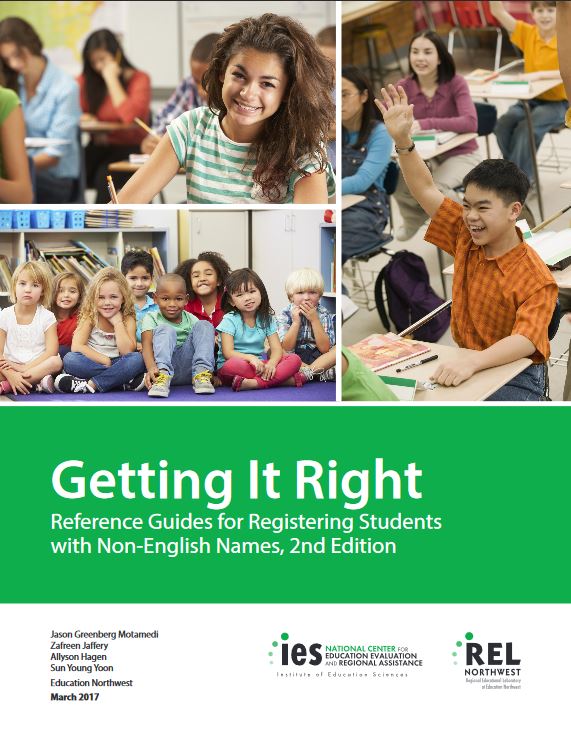 This set of naming conventions guides from IES and REL Northwest can serve as a reference for accurately and consistently entering students' names in school, district, and state databases, as well as addressing and greeting parents and other family members in a culturally responsive and respectful way. The guides are available for students with home languages of Arabic, Chinese, Hindi, Korean, Russian, Somali, Spanish, Tagalog, Ukrainian, Urdu, and Vietnamese.
Online Resources
For more great resources, see the following:




Add new comment