

There are many different funding streams related to the education of English language learners (ELLs). This article provides a very general overview of some of the different streams available. The better you understand how these funds work in your setting, the more informed and involved you can be about decisions that impact ELLs and staffing at the local, state, and national level.
What You Need to Know
Why It Matters
It is helpful for educators, administrators, and staff who serve ELLs to understand how these funds work in order to:
- Use funds appropriately and efficiently
- Explain how the funds work to other stakeholders
- Identify supports that are working and key areas of need
- Engage in local and state policy/budget discussions
- Understand policy discussion and debate at the national level
- Share stories about the impacts of these funds with school leaders, district leaders, and policymakers
For tips on understanding funding in your setting, see the recommendations below.
Author's Note
This list is not a comprehensive list of funding streams, nor should it be interpreted as policy and fiscal guidance. Please contact your district or state ELL administrators for:
- Technical assistance
- Answers to specific questions
- Rules related to allowable expenses
- Information on combining funds
Related Resources
For additional information, we recommend the following:
- Funding English Learner Education: Making the Most of Policy and Budget Levers (Migration Policy Institute)
- Federal Funding to Support the Learning and Success of Multilingual Students (The Children's Equity Project, Arizona State University)
Local and State Funds
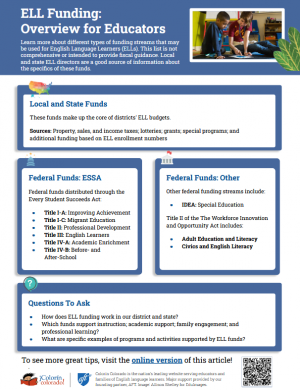
These funds make up the core of districts' ELL budgets. Sources can include:
- Property taxes
- Income and sales taxes
- Lotteries
There may also be additional local or state-level grants and programs focused on ELLs and specific priorities, such as bilingual education. Many states provide additional funding for ELL students or programs based on the number of ELLs enrolled. You can see general ELL information from your state in our ELL State Resources list.
Keep in mind that:
- These systems are complex.
- Each setting has a unique combination of funds that supports ELLs.
- Some rules, guidelines, policies, and programs may also vary across districts or states.
- The percentage of funds that schools get from the federal, state, and local level varies by state. You can see a chart of how that allocation has recently worked in all 50 states in Dr. Julie Sugarman's policy brief.
Dr. Sugarman also notes that schools may also raise money through parent organizations, fundraising, and philanthropy, and they may also arrange for in-kind services through community partners.
Federal Funds: ESSA
Federal funds that support ELL education are mostly allocated through the Every Student Succeeds Act (2015). These funds are distributed to states, who then distribute the funds to districts and schools. Here are several sections of ESSA whose activities may relate to ELLs.
Note: These funds are subject to annual budget approval processes at the federal level. The federal funds for 2026-27 have not yet been appropriated and questions remain about which programs will be funded and at what level, including Title III.
| Title I: Equity and Academic Achievement | |
|---|---|
| Supplements state and local funding to schools and districts with high percentages of students from low-income families | Services might include:
|
| Title I-C: Migrant Education Program (MEP) | |
Supports high-quality education programs for children in migrant farmworker families, including in agriculture, dairy, fisheries, and food processing, who may haved recently arrived in the district or move frequently during the school year due to seasonal demand Note: About 40% of the children MEP serves are ELLs. | Services might include:
|
| Title II: Professional Development | |
| Focuses on a range of professional development initiatives, including those that focus on ELLs or are implemented in schools serving ELLs | Services might include:
|
| Title III: English Learners | |
Supplemental services for ELLs and recent immigrant children. (Many ELLs were born in the U.S. and are U.S. citizens.) Notes:
| Services might include:
|
| Title IV-A: Academic Enrichment | |
Covers a wide range of academic services that were previously funded through separate streams | Services might include:
|
| Title IV-B: Before- and After-School Programs | |
| Designed to support extended-day programs, often in settings serving low-income students | Services might include:
|
More Federal Funds
In addition to ESSA, there are other federal funding streams that may support ELL services, including (but not limited to) the following:
| IDEA | |
|---|---|
Addresses the rights of students with disabilities to receive services that meet their needs, including ELLs Note: ELLs who are identified with a disability have a legal right to both ELL and special education services. They are often referred to as dually identified students. | Services for ELLs with disabilities might include:
|
Adult Education and Literacy | |
Title II of the The Workforce Innovation and Opportunity Act (WIOA) | Services include programs that help adults acquire the basic skills they need including:
|
| English Literacy and Civics | |
| Integrated English Literacy and Civics Education (IELCE) under WIOA Title II | Services include:
|
| Refugee School Impact Grants | |
Refugee School Impact grants have been funded through the U.S. Department of Health and Human Services for a number of years to support students in families served by the U.S. refugee resettlement program. While new grants are not currently being dispensed, some funds may be still available through prior grants. | Related services have included:
|
Understanding Funding in Your Setting
You can learn more about funding in your setting by asking the following questions to your district ELL administrators:
- How does ELL funding work in our district and state?
- Which funds support instruction and academic support?
- Which funds support family engagement?
- Which funds support professional development?
- What are specific examples of programs, services, staff roles, and activities supported by ELL funds?
- Where can I find more information?
- Are there any resources that summarize this information for our district or state?
- Which organizations are tracking these issues in our state?
Examples from the Field
You may also wish to collect concrete examples (including personal stories) to help explain funding to other stakeholders, including administrators, colleagues, families, and public officials. You may also wish to collect data on the ELL population in your district. Here are some examples from how states and districts around the country use federal funds, highlighted in news and research reports. We also include examples of ELL advocates who are working on funding issues.
Title II
- Staffing: In the 2024-25 school year, the state of Colorado allocated $26 million of Title II funds for a variety of professional development activities, including recruitment and retention of effective educators (such as incentives for hard-to-staff schools or subjects) and reducing class size to improve instruction.
Title III
- Tutoring: In Roanoke City public schools (VA), trained tutors help students work on language development during and after the school day. Roanoke's ELL population has doubled in the past five years.
- Bilingual Family Support: In Cincinnati Public Schools, a team of bilingual faculty and staff offers support over the summer to help families with registration and bus transportation. They also share information about the school system. ELLs make up about 12% of the district’s student population.
Migrant Education Programs
- Academic Support: Pajaro Valley Unified School District (CA) serves more than 1,000 migrant education students. Their Migrant Education Program focuses on addressing gaps in students' learning for all ages, from early literacy instruction for pre-kindergarten to language arts and math support for high school students.
- Academic/Social-Emotional Support: Frederick Public Schools (OK) uses their Migrant Education Program to provide "tutoring, summer and weekend reading academies, eye doctor and dentist visits for students, and GED programs for their parents." The district was also recently recognized for students' growth in English language proficiency.
State-Level Examples
- Michigan: Since February 2023, a group of leaders in multilingual education across Michigan has worked collaboratively with statewide advocates to raise awareness of the need for increased funding for English Learners in Michigan, ultimately focusing efforts on fully funding Section 41, a state level grant for EL/Bilingual Education in Michigan. Their collective efforts contributed to a $10 million increase in the FY25 budget. The FY26 budget just was also recently released and includes another 25% increase for Section 41. You can learn more about what's happening in Michigan in English Learner Funding: How Does Michigan Compare to Other States?
- South Dakota: South Dakota established a Statewide Title III Consortium to provide school districts with the option of participating in Title III activities in a consortium approach. By combining resources, the Consortium delivers professional development, regional workshops, and on-site school visits to help districts strengthen Title III goals and programming. This collaborative model currently serves just over 100 school districts across the state.
Related Resources
- Federal Policy and Funding for ELL Education: News and Updates (Colorín Colorado)
- What You Need to Know About ELLs: FAQs (Colorín Colorado)
- How to Make English-Learner Funding 'Fair and Effective' (Education Week)
- Funding English Learner Education: Making the Most of Policy and Budget Levers by Dr. Julie Sugarman (Migration Policy Institute)
- Federal Funding to Support the Learning and Success of Multilingual Students (The Children’s Equity Project, Arizona State University)
- Funding Student Needs: A Review of State Funding Policies for English Learners and Students From Low-Income Backgrounds (Learning Policy Institute)




Add new comment