
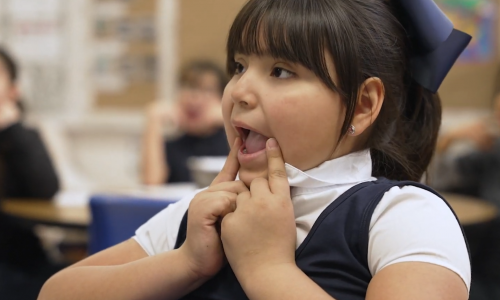
In order to read, children need to learn how the sounds in words work. This ability is a good predictor of a child's later reading success, and children who have a hard time with these skills may have trouble learning to read.
This set of skills is called phonological awareness, or the ability to recognize and work with the sounds of spoken language. It is the foundation for decoding, spelling, and word recognition — even though it focuses on sounds and not on letters. Reading expert Margie Gillis explains that this skill focuses on taking the sounds of words apart. She helps teachers remember that these activities focus on sounds by explaining that they could be done with your eyes closed.
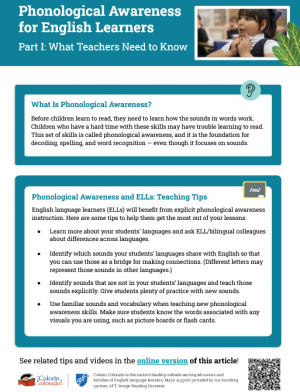
Phonological awareness skills include:
- Learning to produce specific speech sounds
- Rhyming
- Breaking a word into syllables
- Phonemic awareness
The most complex of these is phonemic awareness, which is the ability to recognize and work with individual sounds, or phonemes, in words. This is usually the last skill to develop.
English language learners (ELLs) will benefit from explicit instruction in phonological awareness that takes into account their language and literacy skills in their home language. They will also get more out of this instruction if it builds upon sounds and vocabulary words they already know and if it is scaffolded to support their understanding.
This article provides some ELL considerations for phonological awareness instruction, as well as a basic introduction to key skills you may see in as part of your reading curriculum. It can be used by ELL educators, bilingual educators, classroom teachers, reading specialists, speech language pathologists, paraprofessionals, teacher trainers, curriculum leaders, and others!
Students' Language and Literacy Background
Key terms
Learn more about the difference between phonological awareness, phonemic awareness, and phonics in this explainer from Reading Rockets.
Research has shown that phonological awareness skills that have been developed in a child’s home language can transfer to a second language. For example, if a child has developed rhyme and sound awareness in their home language, those skills can become the foundation for learning to read in English.
However, if students have not yet learned these skills in their primary language, they will need targeted support to learn them in a new language as they also learn new sounds and vocabulary words.
The Home Language Connection
Students' home languages are a valuable asset. You can make helpful connections to students' languages throughout your instruction — and you do not need to speak a student's language to do so! For example, there are multiple sounds in English and Spanish that will directly transfer between languages. Some of those sounds share the same letter ("m") and some of the sounds are associated with different letters (the /h/ sound can be made by a "j" or "g" in Spanish).
It's also important to learn about some of the differences between your students' languages and English. Some sounds may be hard for speakers of that language to "hear" or pronounce in English. For example, Spanish phonology does not include the /sh/ sound, so Spanish speakers may have difficulty producing the /sh/ sound or distinguishing between /sh/ and /ch/, a sound with which they are familiar.
In her chapter of Literacy Foundations for English Learners, Dr. Virginia Lovelace-Gonzalez notes that, "Phonological awareness skills can transfer across languages when students have opportunities to build these skills in their native language and English" (2020, p. 53). She continues, "For ELs, phonemic activities in English can be complicated by having to recognize sounds in English that do not exist in their native language...Instructionally, it is important for teachers to determine some of the similarities and differences between English and the student's native language to ensure the opportunity to learn" (p. 53).
Learning About Students' Languages
- Start by learning more about your students' languages by going to resources such as MyLanguages.org or Omniglot.com.
- Ask bilingual colleagues about how their languages are similar or different from English and common areas that need attention when learning English, particularly in terms of pronunciation. Educators who work closely with ELLs, including ELL teachers, reading specialists, speech-language pathologists, and paraprofessionals, may also have some valuable insights.
- Identify whether there are any sounds that your students' languages share with English and which sounds may be new to your students.
Helping Students Make Connections
- Point out sounds that are shared between languages. (Some examples across different languages are included in Literacy Foundations for English Learners.)
- Ask students if their languages have words that begin with a particular sound. This can work with students who have limited literacy skills in their first language too.
- Find ways to encourage your students: "I can see why you did that! That's how you would say it in Spanish, right? Good job using all of your language skills! Remember, it's different in English. Let's try it again."
Understanding Language Use and Errors
Keep in mind that this information can also help you recognize and address patterns in students' language use and in their errors.
Dr. Elsa Cárdenas-Hagan explains that "errors inform instruction." This is another reason why working with a team whose members have in-depth knowledge about students' home languages is so important — they may have additional insights into how students are using language. This is brought to life in one of our favorite articles, A Word Beginning with "T": "Maestra."
Video: Making Connections with Students’ Home Languages
Dr. Elsa Cárdenas-Hagan talks about the importance of making connections between students' languages and English. She explains that teachers don't have to speak their students' languages to make those connections. She also shares some similarities between English and Spanish.
This video is an excerpt from her Reading Universe presentation, Teaching English Learners: What Every Educator Should Know.
Scaffolding Instruction
There are several steps you can take to scaffold, or support, your phonological awareness instruction so that ELLs get as much out of it as possible. Keep in mind that students who arrive during the school year will need additional support learning skills that were previously taught earlier in the year.
- Use familiar sounds. Phonological awareness skills and activities will be easier to practice with sounds that students already know and can produce.
- Teach new sounds if needed. If you will be teaching a new sound, be sure to plan for time to model the sound and provide students with pronunciation practice.
- Use familiar vocabulary. It’s also important for ELs to practice new phonological skills with familiar words (Brown & Ortiz, 2014, as cited in Lovelace-Gonzalez, p. 53). Otherwise, students may not understand what they are learning — even if they can successfully complete an activity. If needed, teach the meanings of words you’ll be using for phonemic identification practice at the beginning of a lesson with visuals such as images and real objects. You can also include translations of words and sample sentences as part of your instruction.
- Scaffold visuals. Keep in mind that if you are using flash cards, game boards, or other materials with visuals, ELs may need to learn and review key vocabulary words that are pictured. These materials won't be useful if students don't know the English words for the pictures they see!
- Give clear directions. Many phonological awareness activities are similar but vary slightly in the target skill. Some activities may also use manipulatives such as tiles, chips, or feltboards. Be sure to explain and model instructions clearly, ideally in students' languages.
- Check comprehension regularly. Check students' understanding of the activity by using quick comprehension checks, such as thumbs up/thumbs down. Keep an eye on whether your ELs seem to be understanding the activity and make adjustments if needed.
Phonological Awareness Skills
Here are several skills that are commonly included as part of phonological awareness instruction. This information provides a basic introduction to each skill, along with ELL considerations. For specific teaching ideas, see the resources below from our sister site, Reading Universe.
Articulation
- What it is: Articulation is the production of speech sounds.
- Example: Learning to say the /z/ sound
Tips for ELL Instruction
- Find out which sounds your students share with English. This is a good place to start!
- Find out which sounds will be new for your students.
- Model and teach new sounds explicitly.
- Pay attention to student errors. These may be related to patterns from the students' languages.
- It can be difficult to learn how to pronounce a new sound. Give students lots of practice and be patient as they try something new. To try learning some new sounds yourself, take a look at this video that teaches diphthongs in Vietnamese. Notice that the teacher points out sounds that are similar to English, and that both tone and inflection can impact the meaning of a word in Vietnamese. Are you able to replicate different tones?
You can see more examples of how to model different sounds in English in these resources from Reading Universe:
Featured Videos
In the first video, Dr. Cárdenas-Hagan talks about challenging English sounds for Spanish speakers and how students' errors can inform instruction. This video is an excerpt from her Reading Universe presentation, Teaching English Learners: What Every Educator Should Know.
In the second video, third-grade teacher Estella Escajeda helps her multilingual students hear and produce the subtle difference between the short 'i' and short 'e' sounds, providing them with a bridge from Spanish to English by talking explicitly about the connections between the two languages.
Syllables
- What it is: Syllables are parts of a word that are organized around a vowel sound.
- Example: The word window has two syllables: win-dow. The Spanish word calabaza also has four syllables: ca-ma.
Note: Notice that all syllables in calabaza are CV syllables, the most common syllable type in Spanish.
Tips for ELL Instruction
- Find out if students have learned about syllables yet. They can transfer this knowledge if so.
- Learn about syllable patterns in your students' languages that might be different.
- Use hands-on techniques for teaching about syllables.
- Keep in mind that in Spanish, the vowels always make the same sound. This is very different from English, which has many different vowel sounds that change depending on where vowels appear in a word.
Video: Comparing Syllables in English and Spanish
Dr. Cárdenas-Hagan describes six different syllable types in English and how Spanish-speaking students might pronounce them. This video is an excerpt from her Reading Universe presentation, Teaching English Learners: What Every Educator Should Know.
Onset-Rime
- What it is: Onset and rime refer to parts of a word. Onset is the first sound, and rime is the vowel and consonant that follow.
- Example: In the word hug, /h/ is the onset and /ug/ is the rime.
Tips for ELL Instruction
- Explain this skill clearly with examples, and define the terms 'onset' and 'rime' if you are using them in instruction.
- Explain how to use manipulatives if they will be part of your lesson.
- Use familiar sounds and words to teach this skill.
- Keep in mind that 'rime' is different from 'rhyme'!
Rhyming
- What it is: Rhyming words start with different letters, but the rest of the letters (the rime) are the same.
- Example: An English rhyme is game/name. A Spanish rhyme is oro/loro (gold/parrot)
Tips for ELL Instruction
- Find out if students have learned to rhyme. They may need extra practice with this skill if not. Keep in mind that this skill is often taught to young children, but newcomer ELLs may not have learned about rhymes.
- Use familiar sounds and words to teach rhymes.
- Incorporate rhyming into other literacy activities, such as vocabulary practice.
A Note on Spanish
Short vowel sounds may be new to Spanish speakers (and speakers of other languages).
Closed syllables are also not as common in Spanish.
It may be difficult for students to recognize rhyming words in English because they are not familiar with the vowel sounds and not used to listening for rhymes in closed syllables.
Videos: Rhyming in Action
Take a look at the discussion about rhyming embedded within a classroom literacy lesson in this video featuring Dr. Cárdenas-Hagan and Leonor Delgado, a veteran teacher at P.S. 109 in the Bronx. (While this lesson focuses on reading fluency, the conversation about rhyming with students is a helpful model for how to talk about the concept.) This video was produced by our sister site, Reading Universe.
Phonemic Awareness
As explained above, phonemic awareness is a part of phonological awareness, and it is usually the last skill develop. It includes a subset of skills that are critical for decoding, spelling, and writing. To learn more about what should be in place before starting these skills, see these recommendations from Reading Universe.
The following skills are best taught in the sequence listed below since they increase in difficulty. See more ideas for instruction in the resources from Reading Universe below.
ELL Tips for Phonemic Awareness
Keep in mind that for each of these skills and activities, it is important to:
- Give clear instructions and examples, especially since these activities are similar.
- Use familiar sounds and vocabulary, including when using visuals or picture cards.
- Show students how to use manipulatives, such as chips or tiles.
- Enunciate clearly so that students can hear the differences in sounds.
- Don't forget that playing with words and language can be fun! Look for ways to support and celebrate students' success.
| Skill | What It Is | Example |
|---|---|---|
| Phonemic Identification | Identifying a single sound in a word, such as the beginning, ending, or middle sound | What is the first sound in the word map? /m/ |
| Phonemic Segmentation | Breaking a word down into its sounds | What sounds to you hear in the word jam? /j/ /a/ /m/ |
| Phonemic Blending | Learning to blend sounds to form a word | What is this word? /b/ /u/ /s/ |
| Phonemic Manipulation: Deletion | Deleting a sound from a word to make a new word | What if I take away the /d/ sound from the word card? That's right — I get car! |
| Phonemic Manipulation: Addition | Adding a sound to a word to make a new word | What if I add the /t/ sound to the end of car? That's right — I get cart! |
| Phonemic Manipulation: Substitution | Changing a sound in a word to make a new word | What if I change the /m/ sound at the beginning of make to /b/? That's right -- I get bake! |
Videos: Phonological Awareness
Dr. Cárdenas-Hagan offers some tips for teaching phonological awareness. She also works with Emilio, a third grader, on producing the /j/ sound and spelling it with the letter 'g', pointing out the similarities and differences between Spanish and English. To see the complete lesson with Emilio, take a look at:
- One-on-One with an English Learner, with Dr. Elsa Cárdenas-Hagan (Reading Universe)
Related Resources
For ideas on teaching specific sounds, see the following resources from Reading Universe:
- A Guide for Teaching the Letters and Sounds
- How to Pronounce the English Phonemes: An Interactive Demo
- Vowel Valley: Printable and Video
Phonological Awareness
Phonemic Awareness
- Phoneme Identification: Skill Explainer
- Phoneme Segmentation and Blending: Skill Explainer
- Phoneme Manipulation: Skill Explainer
Resources from Reading Rockets
Professional Learning
Colorín Colorado has prepared a slide deck about phonological awareness instruction for ELLs that can be used for turnkey professional development sessions. It features several vidoes and activities for professional learning. Please share attribution to Colorin Colorado.
To get started, you need:
- Phonological Awareness Instruction for ELLs Slide Deck: Includes activities, discussion questions, and videos (also featured below)
To edit this presentation, you can download or copy the slides:
- File > Download (no Google account required)
- File > Make a copy (Google account required)








Add new comment