
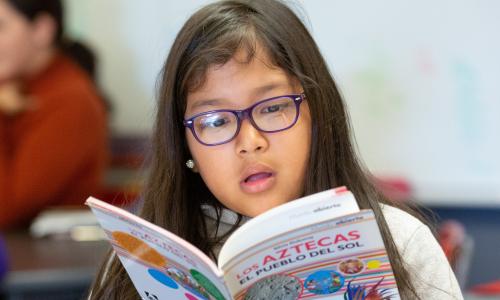
When working with English language learners (ELLs), a critical first step is getting to know your students. Doing so can build community in the classroom, engage students, and inform your instruction and support depending on students' home languages and prior educational experiences. Here's how to get started!
Strategies
Build relationships with students
The first step is to get to know your students, which veteran ELL educators often cite as their most important piece of advice when working with ELLs. Learn more about your students' talents and interests — which can also help inform instruction! These connections will also foster a positive classroom environment where students feel more confident about trying new things and taking risks. In addition, learning about students' lives, languages, and cultures is a first step in making instruction more culturally and linguistically responsive.
Learn about students' prior educational and literacy experiences
Some students will have had regular, uninterrupted schooling, and as a result they will have strong literacy skills in their first language. Others will have interrupted or limited schooling experiences with little literacy experience. You can learn more about your students' background by asking families questions such as:
- How many years of schooling has your child completed?
- Has your child learned to read in [insert the family’s first language here]?
- Has the child had access to books in [insert the family’s first language here]?
It's important not to overwhelm families with too many direct questions at first, but you can introduce your questions by explaining that this information will help you plan instruction for students. We also recommend that you take a look at our sections on special populations of ELLs, including refugees, students with interrupted formal education (SIFEs), and unaccompanied minors.
In addition, keep in mind that even if students have limited schooling, they may have strong literacy experiences at home with their families.
Find students' current English language proficiency (ELP) levels in reading, writing, speaking, and listening
Keep in mind that students ELP levels may vary across different skill areas. If you aren't sure how to find this information, ask your ELL colleagues or administrators how to proceed. ELL specialist Becky Corr recommends the following:
"Think about a particular lesson and what the student is being asked to do with language. Teachers should consider which activities they might incorporate to promote language development as these activities would be beneficial for all students. For example, if a lesson focuses on writing, a teacher may incorporate a speaking activity to elicit the vocabulary needed for the writing lesson. Considering which scaffolds might be useful, such as graphic organizers and visuals, to name a couple, is also necessary."
Note: Having concrete data about students' language and literacy background can also help guide your decisions if students need additional support.
Students' Literacy Levels
Here are some additional things to consider as you get to know more about students' prior literacy skills.
In addition, students' literacy skills are an important resource that can be used to make connections to reading in a new language, such as recognizing cognates (words related across two languages).
| What You Need to Know | Home Language Connection | Teaching Tips | |
|---|---|---|---|
Students Have Literacy Skills in English and Their Home Language | Students have literacy skills across multiple languages to draw from. | Use students' home languages to help them:
| Focus on:
|
Students Have Literacy Skills in Their Home Language | Students can draw from literacy skills in their home language. | Share connections between languages, such as:
You can also explain that decoding skills they have learned can be applied in English. | Students will need explicit instruction in:
|
Students Have Limited Literacy Skills | Students' oral language skills can be a resource when teaching sounds and letters. | Share connections between languages, such as:
| Students will need explicit, targeted instruction in core skills:
|
Collaboration
Ideally, a team can support students' literacy development by connecting skills practice to content instruction and language development. As noted above, different educators bring different kinds of expertise to the table.
If students have very little literacy background, it's important to get them targeted reading instruction as soon as possible, no matter their grade level. Talk with colleagues and administrators about how students will receive that instruction, who will provide it, and when it will happen. It's also important to limit the amount of time that students miss core instruction. For example, a elementary school in Virginia scheduled its language arts team push into classes for literacy instruction so that students could get small-group, tailored instruction without leaving the classroom. Read more in The PRESS-In Model: Turning All Students into Readers.
Older students still need to develop the same kind of skills as younger students, but they may respond more positively to materials that aren't created for young children. If more formal instruction is needed for a group of students or targeted supports aren't currently available at the level your students need, talk with administrators about ways to schedule that support.
Related resources
Learn more from the following articles and resource sections:
- 8 Strategies for Building Relationships with ELLs
- How to Create a Welcoming Classroom Environment for ELLs
- 10 Things You Need to Learn About Your English Language Learners
- Literacy for ELLs: Resource Gallery
- Reading 101 for English Language Learners
- Phonics Instruction for English Language Learners
- Phonics Instruction for Middle and High School ELLs
- Essentials of Adolescent Literacy Instruction (AdLit.org)
- It took 20 years for this author to reunite with the teacher who changed his life (NPR)
Related Videos
You Are Welcome Here: Supporting the Social and Emotional Health of Newcomer Immigrants
You Are Welcome Here (#DearbornWelcome) is an award-winning 20-minute film from Colorín Colorado highlighting how the Dearborn, MI public school district is helping its immigrant students succeed. The film features Salina Elementary School and Salina Intermediate School in the South End of Dearborn, which serve large populations of families from Yemen.




Add new comment