
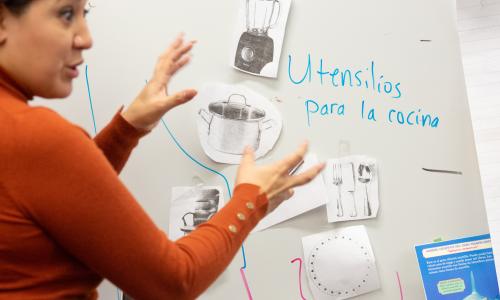
When working with ELLs, students' primary languages are a powerful tool that educators can use — even if they don’t speak those languages or are working in a classroom with students who speak many languages.
Here are some ideas to help you get started! These tips are geared towards classroom and content-area instruction; for ideas that are related to literacy instruction, see our related article (coming soon!).
Getting Started
1. Welcome students' languages in the classroom.
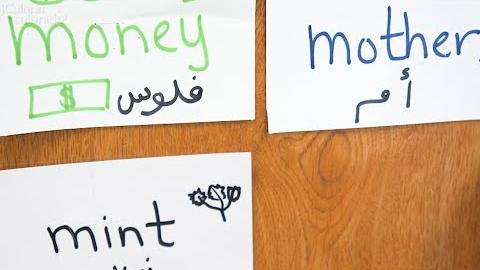
- Post signs and labels in students' languages.
- Include bilingual books in your classroom library or materials.
- Talk about the benefits of being bilingual with your students and share examples of bilingual individuals with your students.
- Keep in mind that students may have advanced translation skills and may be helping their families translate during appointments, errands, and daily interactions.
2. Find out what languages your students speak.
You can learn more about the languages your students speak by talking with:
- Students
- Families
- Colleagues
This information may be included in student records or the home language surveys that families fill out.
In addition, it is helpful to find out if any of your colleagues speak students' languages. Staff who speak students' languages, such as bilingual teachers, family liaisons, interpreters, or other professionals, can be an important resource and may be able to provide helpful insights. Confirm whether they feel comfortable being approached in that role and clarify the best way to approach them with questions.
Note: Avoid assumptions about what languages students speak based on their name or appearance. In addition, keep in mind that some students may be hesitant to share their language background, as in the case of some Indigenous students from Latin America.
3. Identify resources in students' home languages.
You may be able to find books, reference materials, and online resources in students' languages. Verify the quality of resources with a bilingual colleague or another trusted source. You can also ask your ELL/bilingual colleagues and school librarian for other ideas.
Classroom Strategies
4. Allow students to brainstorm, read, view, and write drafts in their home languages.
Reading and viewing content in students' home languages is a great way to build background knowledge for writing and discussing. Give students a chance to brainstorm ideas and write first drafts (either individually or in small groups) in their home languages in order to capture their thinking. Whether students are reading, listening, writing or speaking, they will be able to tap into their existing background knowledge. If you wish to review or assess their notes or drafts, you can provide a graphic organizer in which they summarize key points or ask them to share their thinking in English after the brainstorm.
5. Encourage peer learning.
Using students' home languages in the classroom can:
- Help build comprehension
- Deepen understanding
- Build confidence
- Give students the chance to express themselves
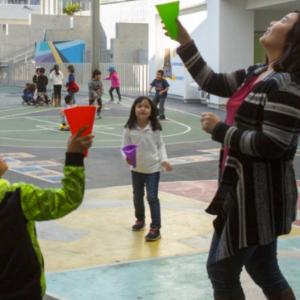
Give students the chance to work on complete assignments or work on projects together with peers who speak their language. You don't have to use this grouping all the time, but consider when it might be helpful for students to work in their home languages.
Allowing students to work in their native language
Teachers often worry that students will be off-task if they are working in their home language. In my experience, students are more focused because they can engage naturally with the content and delve deeper into the activity together. I set parameters and put scaffolds in place for reporting out in English. When students are "off-task" or misbehaving, a teacher can generally tell from body language and noise level.
— Kristina Robertson, EL Administrator, Roseville, MN
6. Teach students to recognize cognates.
Cognates are words that are related across languages and they are a powerful tool for ELLs. English shares cognates with many languages, and in particular with Spanish (plant/planta). Teaching students to recognize cognates can help increase their vocabulary. For more ideas on how to teach cognates, see our Cognates strategy.
7. Use multilingual glossaries.
Multilingual glossaries present vocabulary words with translated terms; they may also include translated definitions, visuals, sample sentences, and other scaffolds. They can be presented as a document or as a slide deck with visuals. See examples in our Multilingual Glossaries strategy.
Note: When translating terms, be sure to give students practice using the words they are learning through all four language domains (listening, speaking, reading, and writing). In addition, consider translating related terms that might be more common than the academic words.
8. Use translated text strategically.
Providing translated texts can be a helpful scaffold for students at varying levels of language proficiency. You may wish to use these texts to build or connect to existing background knowledge or to preview key concepts in a passage. This can be an especially helpful bridge for students who are in early stages of learning English and have literacy skills in their primary language.
Remember: the purpose of a scaffold is to eventually remove it, and the goal is not to translate everything! Consider how the use of translation is supporting students' understanding, and how it is supporting students' developing skills in English. For example, another strategy you can use is text engineering, which embeds scaffolds into grade-level text such as headings, visuals, synonyms, cognates, definitions, and translated terms. This draws upon students' home languages but requires them to work with the text in English.
9. Encourage students to draw upon all of the languages they know.
Students who speak multiple languages have linguistic resources in all of their languages. For example, sometimes students will:
- Use words from their home language when they don't know the word in English
- Mix words from different languages in a sentence
This way of using language is not a sign of confusion; it's a sign that they are drawing on their multilingual skills! In fact, students often mix words in a way that follows appropriate usage rules from both languages.
Many children's books feature words from other languages, such as:
- I Love Saturdays y domingos by Alma Flor Ada (I Love Saturdays and Sundays)
- Isabel and Her Colores Go to School by Alexandria Alessandri
- La Princesa and the Pea by Susan Middleton Enya
- Cora Cooks Pancit by Dorina K. Lazo Gilmore
Sometimes students will also create new ways of using language or even create new words. For example, if a Spanish-speaking student says, "I want nar-ange juice," the student is likely combining the English and Spanish words for "orange" ("orange" / "naranja") in her speech.
The academic term for using all of your language assets is called translanguaging. You can support translanguaging by welcoming students to use their languages, sharing examples of translanguaging through books, writing, and music, and continuing to incorporate students' languages in your instruction.
At the same time, you can also help students become more aware of how language works and how they are using language — building their metalinguistic awareness. Within your instruction, ask students:
- How to say something in their home languages
- How the meaning changes in their languages
- If they have a word for an English term
Related resources include:
- Bilingual Picture Books: Stories Featuring Spanish Vocabulary Words
- A guide to translanguaging in the classroom (WIDA)
Expert voices
"The word 'Mamá' does not mean the same to me as 'Mom.' It has a different feel, a different connotation...Language is culture. You can't separate those two."
10. Consider your use of translation apps and AI tools.
There are many translation apps and tools built into learning platforms and AI tools, and new ones are being added all the time. These powerful tools can be used to identify cognates, create multilingual glossaries, translate text into different languages, and translate spoken speech. For examples of AI-generated multilingual resources, along with prompts that incorporate students' home languages, see Put On Your GLASSES: Writing AI Prompts for ELLs.
However, as noted above, it is possible to become over-reliant on any type of translation tool. Ask yourself how the tool is helping support students' comprehension and expression in English, and what steps you are taking to reduce the use of the tools over time.
Discussion Questions
- What is a strategy that you could try in the near future?
- What types of resources would you like to have in your students' languages? Where might you look for them?
- Do you think the outcome of the following assignment might be the same or different?
- Write a paragraph about why leaves change color in the fall. The paragraph must be completely in English.
- Write a paragraph about why leaves change color in the fall. Write as much as you can in English; use words in your language if needed. We will look up those words for the next draft.
- Imagine you are learning a new language. How might the above assignments (written in your new language) compare based on your own language level?










Add new comment