
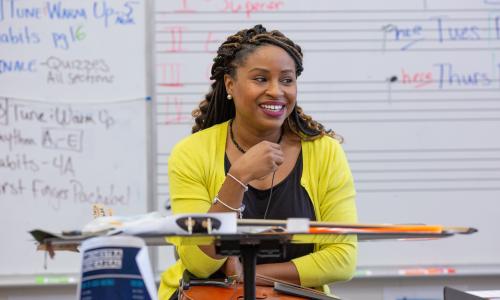
Music classes and clubs can be an important opportunity for English language learners (ELLs) to make friends, participate in the school community, learn new skills, and pursue their interests.
Here are some ways that music educators can support their ELLs in the classroom and beyond.
Getting Started
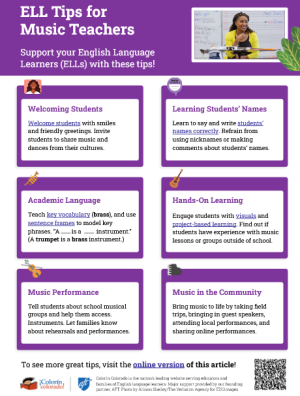
Music class may be new for ELLs. When you meet students, tell them a little bit about the class, how often you meet, and how to find the music room if needed.
Welcoming Students
Welcome your students in the following ways:
- Greet students with warm smiles.
- Introduce yourself with the name that students should use.
- Learn to say students' names correctly.
- Look for opportunities to involve students and ask for their help with special jobs or tasks.
- Keep an eye out for bullying due to language, accent, country of origin, cultural customs, food, dress, or immigration status. Address any bullying you see immediately.
Teaching Immigrant Students
All students have a right to a free public K-12 education, regardless of their (or their parents') immigration status. Students should never be asked about their immigration status by school staff.
Getting to Know Students
- Learn more about students' interests and talents.
- Ask students what kinds of music they enjoy.
- Find out if students have experience with music lessons or musical groups outside of school, such as a band or a choir.
- Keep in mind that students may already have different types music knowledge, skills, and talents.
- In addition, keep in mind that students may have technical and multimedia skills that include adding music to video or reels, mixing music, using music-related apps or software, and managing an online channel.
Culture
Welcome students' cultures by:
- Showing respect for students' customs
- Inviting students to share music and dance from their cultures
A Friendly face
Every adult in a school has the opportunity to make a positive difference for a student. When former ELLs recall their school memories, they often recall moments of kindness from individual staff members or teachers.
For example, consider this conversation shared by Jan Anglade, an ESOL teacher in Georgia:
Me: "So you like this school and the teachers?"
Student: "Yes, I like it. You are my favorite teacher."
Me: "But I'm NOT your teacher. You have never been in my class."
Student: "Yes, but you are nice to us, and smile, and talk to us, and say good morning to us."
Music Instruction
There are lots of ways to support ELL instruction in music class! Here are few high-impact strategies to help you get started, with links to more information about how to use each strategy.
Background Knowledge
- Keep an eye out for the background knowledge students will need to support their learning.
- Look for ways to connect content to students' experiences and find out what students know about a topic.
- Build new knowledge where needed.
Scaffolds
Scaffolds are temporary supports that give students access to grade-level content. Just like the scaffolds used in building construction, scaffolds are taken away when they are no longer needed.
As you teach new content, you can use scaffolds such as:
- Visuals (A poster of different stringed instruments)
- Graphic organizers (A chart comparing two different types of music)
- Realia and manipulatives (A metronome)
- Sentence frames ("A __ is a __ instrument." // A trumpet is a brass instrument.)
- Translated texts
Find more tips on how to use these scaffolds from our ELL Strategy Library.
Vocabulary
Teach key vocabulary, such as:
- Academic words (brass)
- Words with multiple meanings (note)
- Homophones (beat/beet)
- Common words used in a lesson or text (score)
Language Skills
ELLs are developing four different kinds of language skills: listening, speaking, reading, and writing. Look for ways to incorporate all four skills into your lesson. Here are some examples:
- Listening: Provide students the lyrics of a song with some words missing (a cloze activity). Listen to the song and have them fill in the words. If needed, provide a word bank and go over the word meanings first.
- Speaking: Ask students to brainstorm ideas for making instruments from recycled materials.
- Reading: Give students a short passage to read about a famous musician. Provide key vocabulary words as needed.
- Writing: Ask students to listen to a piece of music and write a few sentences about how it made them feel. Provide key vocabulary and a sample text as an example.
Students' Languages
Students' languages are a valuable asset! You don't need to speak students' languages in order to use them to support instruction. You can use:
- Multilingual glossaries: Glossaries that include terms and definitions in English and students' languages.
- Cognates are related words in two languages (e.g., the English-Spanish pair information/información). Many languages share cognates with English, including Spanish, which is the most common language spoken among ELLs in the U.S. You can teach students how to recognize cognates. To see cognates in action, see the section on vocabulary instruction in the "One-on-One" video below with Dr. Elsa Cárdenas-Hagan.
Comprehension Checks
Use quick comprehension checks to track student understanding, such as thumbs up, emojis, exit tickets, or open-ended questions. These are more effective than asking, "Do you understand?"
Hands-on Learning
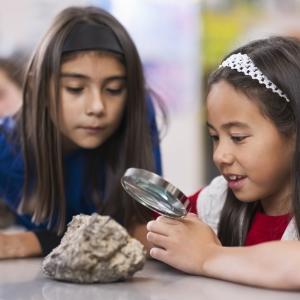
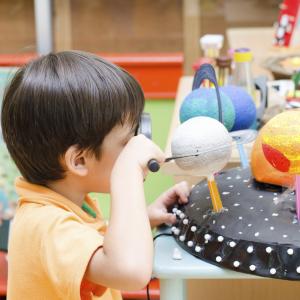
- Use project-based learning to bring content to life and engage students.
- Use books written for children, middle grades, and young adults that highlight special activities. You can find titles by topic in our Colorín Colorado’s Book Finder, as well as in the booklists below.
Collaboration
Your colleagues can be valuable partners in your work supporting ELLs. This includes:
- Other instructors and classroom teachers
- Colleagues who work closely with ELLs and ELL families, such as family liaisons, bilingual teachers, and ESL specialists
- If you have questions or issues that need to be addressed, reach out to colleagues who can brainstorm ideas together. Everyone's role and perspective is valuable!
Connecting to the Community
Share music beyond the classroom by:
- Taking field trips
- Bringing in guest speakers
- Sharing online performances
- Attending local performances
- Sharing information about local art camps, classes, and music lessons
- Looking for opportunities to participate in local music projects and performances
Note for field trips: Make sure to provide translated information and permission slips for field trips.
Family Outreach
Schools should have clear guidelines about how to communicate with multilingual families and available language resources, such as interpreters, language lines or apps.
In addition:
- Treat families with respect and patience.
- Welcome families to school events.
- If possible, attend back-to-school night or other events so that you can meet students and families together.
Translation apps
Translation apps can fill in gaps where needed. Your school may already be using an app like this with families, and if so, it can be a helpful resource for school staff.
Translation apps are best for quick questions, reminders, and straightforward issues. They are not appropriate for sensitive communication — and they are not perfect. They also can't take cultural considerations into account the way that bilingual, bicultural staff members can.
Music Groups and Performance
Musical groups, clubs, and activities can be a great way to engage students and open new doors for students. Principal Mark Gaither notes,
This is about exposure to opportunity and expanding the horizons for our kids. These are life-changing moments, when a child finds a love and an aptitude, and they all of a sudden see broader possibilities of what their life could be like.
Musical groups can also be a way to connect students with their cultures. Keep in mind that ELLs may not be aware of these opportunities. Music educators can play a critical role in:
- Ensuring that students and families are aware of school musical groups and clubs
- Encouraging student involvement
- Supporting access to instruments
- Ensuring students are able to fully participate in activities
- Ensuring families have information about practice schedules, performances, and scholarships
- Looking for ways to engage students and families through musical groups and performances
Keep in mind that information related to registration, practices, schedules, school events, and fundraising may be new to families. Look for ways to give families the information they need.
Related Resources
Articles and News Headlines
- Engaging English Learners in Music (Virginia Department of Education)
- How mariachi programs keep students like me culturally connected in college (EdSource)
- Music brings learning and hope to Bronx school with dozens of new migrant students (Chalkbeat New York)
- ‘Going Varsity in Mariachi’ documentary spotlights competitive high school competitions (PBS News Hour)
Booklists
Books for Children
- Art, Music, and Dance: Books for Young Children
- Art, Music, Dance, and Drama: Asian Pacific American Heritage
- Dance and Dancers: Hispanic Heritage
- Music and Dance: American Indian Heritage
- Music and Musicians: Hispanic Heritage
- Music for Kids: Hispanic Heritage
Books for Middle Grade and Young Adults
Professional Learning
This Colorín Colorado slide deck can be used for turnkey professional development sessions. Please share attribution to Colorín Colorado.
To get started, you need the slide deck below, which includes activities, discussion questions, and speaker's notes.
We recommend customizing these sessions with screenshots of related platforms, policies, or resources from your setting.
To edit this presentation, you can download or copy the slides:
- File > Download (no Google account required)
- File > Make a copy (Google account required)




Add new comment